
Archive
September 12, 2026

▾ Hover for summary ▾ Tap for summary
Thailand's Ministry of Interior has submitted a 750 billion baht budget proposal to install rooftop solar panels on 1.5 million households (increased from an initial 1 million target), with 50,000 baht subsidy per household. The project has cleared the initial screening committee and awaits Cabinet consideration. Officials deny vendor lock-in concerns, noting 2,300+ registered installation companies are available; the state-run utilities (MEA and PEA) will handle ~300,000–400,000 installations directly while contracting private firms for the remainder. Installation requires smart meters and two-way grid connections before subsidies are paid out.

▾ Hover for summary ▾ Tap for summary
Chiang Mai Airport expects significant growth with five airlines adding six new routes during the winter schedule (late October 2025 onwards), including Etihad's Abu Dhabi connection and expanded service to Zhongdong, Shanghai, and Incheon. Full-year passenger projection of 9.97 million reflects strong recovery post-COVID and increasing connectivity, with Chinese and South Korean visitors comprising over 50% of international traffic. The airport has already deployed six new aircraft bridges and is accelerating infrastructure projects to handle capacity growth.

▾ Hover for summary ▾ Tap for summary
This article reframes Industry 5.0 adoption for Thai SMEs, emphasizing that successful digital transformation starts with identifying operational problems—especially data management and workforce readiness—rather than chasing new technology. Real-world case studies (Kenvue) demonstrate practical ROI: a data analytics tool enabled one planner to manage 30 production lines instead of 4, freeing staff to focus on complex decisions. Key takeaway: Thai manufacturers should assess organizational readiness using frameworks like Thailand Industry 4.0 Index and Three Plus Framework (with Data as foundation) before investing in AI or automation, ensuring projects compound rather than fragment.

▾ Hover for summary ▾ Tap for summary
Thailand's Tourism Authority (TAT) is launching the third annual "Amazing Green Fest 2026" on 11–13 September at Sanam Luang, Nakhon Pathom, with the theme "Travel Changes City, Green Changes World." The event aims to advance sustainable tourism through 8 interactive zones spanning storytelling, local entrepreneurship, organic products, sustainable dining, innovation, youth education, workshops, and knowledge exchange. TAT is positioning this as a flagship initiative to elevate Thailand's tourism brand under SDG principles, expand low-carbon hotel standards (CF Hotel), and channel tourism revenue to 55+ community tourism networks across secondary cities and the Wellness Valley initiative.

 Empower businesses to thrive in the digital age.

▾ Hover for summary ▾ Tap for summary
Deputy PM Yutthasak Sutin outlined a five-pillar education transformation strategy at Khon Kaen University's innovation fair: Hope to Discover (personalized education via AI), Hope to Learn (lifelong learning via credit banking), Hope to Work (industry-education linkages), Hope to Rise (merit-based valuation), and Hope to Dream (innovation/problem-solving). The vision reframes education as a "Human Development System" and critical infrastructure for sustainable national development, using AI to reduce inequality and shift from standardized to personalized learning.

▾ Hover for summary ▾ Tap for summary
Former PM Chuan Leekpai warns that Thailand's independent agencies—designed as oversight mechanisms to strengthen democracy—are increasingly subject to political interference and compromised legitimacy. He cited historical examples of the Election Commission (ECT) being corrupted (bribery, falsifying records) and the executive branch overreaching into judicial authority. He argues that without strict adherence to integrity and good governance, these institutions risk failing their democratic mandate, and that current political pressure on budget allocation for agencies like the ECT exemplifies ongoing institutional capture.

▾ Hover for summary ▾ Tap for summary
A royal initiative to revitalize Rattanakosin Island combines cultural heritage preservation, environmental restoration, and quality-of-life improvements for Bangkok residents. Key projects include waterway cleanup (connecting three major canals), green bridge networks linking historic temple areas, and a Fort Mahakam history museum—with ~70% community buy-in already achieved. Design priorities emphasize heritage enhancement over aesthetic makeover alone.
▾ Hover for summary ▾ Tap for summary
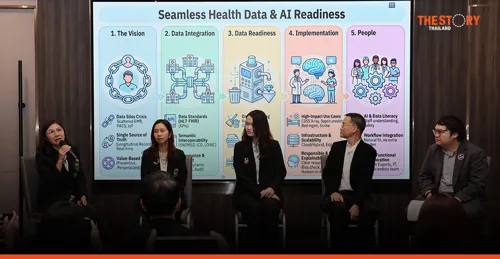
Thailand's healthcare system is advancing AI implementation through three critical initiatives: (1) establishing unified health data infrastructure to replace siloed systems and reduce data duplication; (2) developing domestic AI models trained on Thai population data with rigorous testing protocols (sandbox, ISO 13485 compliance, 4-year development cycle); and (3) expanding patient access via digital platforms. Key barriers being addressed include data interoperability, model validation for population-specific accuracy, and building AI literacy among medical professionals. The Ministry of Public Health and Department of Medicine are coordinating 6 datasets in 2026 to support policy-making and cost reduction.
 Your real translator for LINE and Discord.

▾ Hover for summary ▾ Tap for summary
Opinion piece analyzing the recurring Buddhist temple scandal in Thailand, focusing on embezzlement and misconduct by high-ranking monks. The author argues that media coverage and public discourse fail to address systemic institutional issues—namely Thai Buddhist practices that enable corruption through wealth accumulation, reverence for supposedly infallible monks, and cultural associations between karma and material success. The article contends that Thailand's approach to Buddhism itself may be perpetuating and escalating these moral failures rather than treating them as isolated incidents.

▾ Hover for summary ▾ Tap for summary
Thailand's Justice Ministry announced proactive initiatives to combat online scams and household debt. The ministry recovered 130 million baht for online fraud victims (nearly 700 cases) through asset sales and money-tracing operations at the ACSC, while debt mediation sessions across 23 provinces helped over 40,000 debtors reduce liabilities by 5+ billion baht—in some cases cutting monthly payments from 10,000–15,000 baht down to 1,500 baht. The effort emphasizes speed, accessibility, and community justice through neighborhood justice centers and the Justice Fund.

▾ Hover for summary ▾ Tap for summary
Bangkok launched a second "Housing Matching" event pairing residents with suitable properties, introducing a "rent-to-own" model to help consumers access housing within their budget while helping developers clear excess inventory. The platform has 455 registered users (mostly salaried workers earning 25K–300K baht/month), with 60 units matched in the first event. The second event (Oct 9–11) targets 1,000 units in the 1–3 million baht price range from 30 participating developers, addressing key barriers: low income confidence, insufficient income documentation, and poor credit history.

▾ Hover for summary ▾ Tap for summary
Thai oil pipeline operator BFPL (Bangchak subsidiary) conducted comprehensive testing on the Fuel Road oil pipeline after oil-contaminated water was found in drainage systems. Pressure tests at 28 barg for 1 hour showed no abnormal pressure drops or leaks. The company will conduct additional ultrasonic scanning (UT), radar scanning, and intelligent pig inspection across 1km of pipeline before seeking Department of Energy approval to resume operations. This addresses operational continuity for oil transport while maintaining safety standards under multiple regulatory oversight.

 Want to buy or sell a business?

▾ Hover for summary ▾ Tap for summary
Sony canceled its partnership with Kojima Productions on the game Physint due to ballooning development costs, project delays, and Death Stranding's failure to meet sales targets. Bloomberg reports the game exceeded budget significantly and fell behind schedule; Sony's contract was only time-exclusive (not platform-exclusive), allowing potential moves to other publishers like Microsoft. Key Sony executives close to Kojima have reportedly departed, possibly straining the 30-year relationship between the companies.

▾ Hover for summary ▾ Tap for summary
Thai authorities seized over 50 million baht in unregistered GLP-1 weight-loss injection pens sold illegally online under the "Haus of Peptides" brand, generating an estimated 8 million baht monthly. The operation highlights growing regulatory risks in e-commerce and SME health-tech sectors as unauthorized medical products proliferate through social media. Sellers face up to 5 years imprisonment, and the case underscores the need for stricter compliance frameworks for health products sold digitally—a concern for legitimate online pharmacies and health retailers expanding in Thailand.

▾ Hover for summary ▾ Tap for summary
Shopify shifted its mobile app strategy from cross-platform React Native (adopted in 2020) back to native iOS/Android development, leveraging LLMs to accelerate coding and reduce maintenance overhead. They demonstrated the approach by rebuilding their flagship Shop app natively in 12 weeks, then systematized the migration using an internal tool called Helix that chunks code into checkpoint-validated segments for AI transformation. This signals that AI-assisted development is reshaping the cross-platform vs. native tradeoff—relevant for Thai SMEs evaluating tech stack decisions.

▾ Hover for summary ▾ Tap for summary
Nvidia is reportedly in discussions to invest $10 billion in Anthropic's IPO, signaling major capital deployment in AI infrastructure. This deal reflects intense competition among chip makers to secure strategic positions in the generative AI space and could influence global AI supply chains. For Thai SMEs, this underscores the consolidation of AI computing power and potential long-term implications for AI service pricing and accessibility in the region.
 Together GoWeGo! Ferry tickets in Thailand.

▾ Hover for summary ▾ Tap for summary
Thailand's central bank is launching a "Capital with Purpose" initiative to redirect capital allocation toward high-potential businesses, create opportunities aligned with global ESG standards, and reduce informal economy leakage. The program targets three pillars: channeling capital to viable SMEs, generating opportunities from emerging challenges (especially green trade barriers), and combating illicit financial flows. This signals a systemic shift in BoT's role from financial stability alone to broader economic development supporting SME resilience and sustainability.

▾ Hover for summary ▾ Tap for summary
US inflation remained flat at 3.4% year-over-year in August, showing minimal progress toward the Fed's 2% target amid pressures from Middle East tensions, tariffs, and data center expansion. KResearch expects the Fed to hold rates at 3.50-3.75% at the 15-16 September FOMC meeting, but signals clearer indications of future rate hikes if inflation pressures persist. Rising oil prices and sticky core inflation are key risks, though the decision faces political pressure from Trump ahead of midterm elections.

▾ Hover for summary ▾ Tap for summary
Roblox is extending its AI-powered game creation tools beyond its native ecosystem, enabling developers to build virtual worlds using text prompts. This signals a strategic shift toward making game development more accessible to non-technical creators and could influence how Thai indie developers approach game production, though broader platform independence implications remain unclear.

▾ Hover for summary ▾ Tap for summary
Former PM Srettha argues that Thailand's water crisis stems from fragmented government data systems rather than infrastructure alone. He advocates building a unified "Open Water Data Platform" where all agencies—central, provincial, and local—access the same real-time water data (levels, rainfall, flood risk, dam status) to make coordinated decisions. This data infrastructure approach would also enable fair, transparent compensation for residents who sacrifice land for public flood protection, and improve SCADA control systems for critical river basins. The column emphasizes that data integration is both a technical and equity issue.

 Stop running your company on Excel.