
Archive
August 6, 2026

▾ Hover for summary ▾ Tap for summary
Thailand's cabinet has approved a 7.2-billion-baht water reservoir project (Wang Tone Canal Dam) in Chanthaburi to support water security and the Eastern Economic Corridor (EEC) with capacity of 99.5 million cubic meters serving 87,700 rai. However, it faces strong environmental opposition from the Sustain Foundation and civil society groups, citing inaccurate environmental assessments and potential loss of protected forest and wildlife habitat in Khao Sip Ha Chhan National Park, including potential impacts on wild elephants. A lawsuit has been filed to annul the project's environmental approval.

▾ Hover for summary ▾ Tap for summary
Prime Minister Anuwat Charoenvierakul outlined a strategic vision for Thailand's competitiveness in an unstable global landscape, emphasizing three concurrent pillars: human capital development, innovation, and civil service reform. Key initiatives include decentralizing development (creating multiple economic hubs), leveraging geographic/logistics advantages, implementing a data-driven credit assessment system (via central bank) to improve SME access to capital, and a 4P AI framework. The Bank of Thailand focuses on capital allocation efficiency and combating informal/corrupt capital flows. This signals concrete policy momentum on SME financial inclusion and structural economic reform.

▾ Hover for summary ▾ Tap for summary
Global wellness economy grew from $4.7T (2019) to $6.8T (2024), with Thailand's wellness tourism segment expanding 36.4% annually. BDMS is positioning "Vela" as an integrated health/hospitality model targeting long-term affluent visitors. Thailand's strategic advantage—natural resources, cuisine, traditional medicine, and medical expertise—can be unified under a "Better Living Destination" brand, shifting from volume-based tourism to higher-margin wellness stays. Key opportunity: bridging the ~10-year "health span" gap between life expectancy and active healthy living.

▾ Hover for summary ▾ Tap for summary
GSMA Intelligence projects the Asia Pacific mobile economy will reach $1.4 trillion, representing significant growth opportunity across the region. This macro-level outlook is relevant for understanding market expansion potential for Thai SMEs and tech enterprises operating in or targeting the mobile services ecosystem.

 Empower businesses to thrive in the digital age.

▾ Hover for summary ▾ Tap for summary
Mother's Day spending in August 2026 reached 11.1 billion baht, growing just 0.7% year-on-year—the slowest pace in two years. Over half of consumers (54.3%) kept spending unchanged; 23% increased and 22.7% cut back. Rising cost of living and debt pressure forced consumers to skip gifts (40.9% bought nothing, up from 29%), avoid out-of-province travel (9.4% vs 21.8% last year), and shift toward budget dining. Nearly 80% say current prices directly impact their Mother's Day plans. Online gift purchases surged to 20.7% from 4.3%, while cash gifts and flowers remain most popular. Financial fragility persists: 48.7% have just enough income with no savings buffer, while 23.5% are inadequately covered and borrowing.

▾ Hover for summary ▾ Tap for summary
TITLE (a Phuket luxury property developer) reported H1 2025 revenue of ฿2,004M, up 377% YoY, with net profit surging 1,358% to ฿293M. The company holds a substantial backlog of ฿22,981M expected to materialize through 2026. Key upcoming deliveries include The Title Heritage Bang Tao (฿6,000M) in H2 and the first villa series, The Title Villa Estella (฿500M, 100% sold). Beyond residential, TITLE is expanding recurring income through hospitality: launching The Salute beachfront dining concept this year and developing 3 hotels with IHG globally. Strong pre-booking discipline (75% deposits collected before delivery) has kept cancellation rates near zero despite market turbulence, supporting consistent revenue recognition across seasons.

▾ Hover for summary ▾ Tap for summary
Thailand's Department of Intellectual Property and the National Science Technology and Innovation Policy Office (NSTDA) are jointly launching "IP x Venture Rise Thailand 2026" (27-29 August 2026) to bridge the gap between lab research and commercial market. The event will showcase 250+ research projects across five tech clusters (HealthTech, AgriTech, AI, FoodTech, CleanTech) and facilitate business matching between researchers, entrepreneurs, investors, and technology owners. The collaboration aims to commercialize Thai innovation, strengthen competitiveness, and boost economic value through structured IP protection and capital linkage—addressing a systemic bottleneck in Thailand's innovation-to-revenue pipeline.

▾ Hover for summary ▾ Tap for summary
Thailand's SME competitiveness index fell 0.8 points to 45.1 in Q2, staying well below the 50-point growth threshold across all three sub-indices (business situation, operational capability, sustainability). Survey of 641 businesses nationwide reveals micro-enterprises (65.7% of sample) are hit hardest at 38.5 points, while debt levels (37.5 index) and costs (40.9 index) are the primary drag. Year-on-year, 31.1% report declining revenue and 37.3% report shrinking profits. The government's "Thai Help Thai Plus 60/40" scheme shows positive impact on 79.2% of entrepreneurs, but headwinds persist.
 Your real translator for LINE and Discord.

▾ Hover for summary ▾ Tap for summary
Thailand's largest state-owned commercial bank announced its new decade strategy centered on data-driven innovation, digital platforms (Krungthai NEXT, Pao Tang app), and sustainable governance. The bank aims to expand financial access across customer segments through partnerships, tech transformation, and sustainability initiatives—positioning itself as a key economic enabler amid AI adoption and climate transitions.

▾ Hover for summary ▾ Tap for summary
European retailers (IKEA, Rewe, Edeka) are implementing "Quiet Hour" programs—designated periods with reduced sensory input (dimmed lights, no music, no announcements)—to serve neurodivergent customers with autism, ADHD, sensory processing sensitivities, and other conditions. The concept, originating in New Zealand, is expanding rapidly across retail, cinemas, museums, and lifestyle venues as inclusive marketing strategy. Thai SMEs can adopt this customer-centric approach to differentiate their service offering and capture underserved customer segments seeking low-stimulation shopping environments.

▾ Hover for summary ▾ Tap for summary
A Thai columnist argues that the digital economy is creating "techno-feudalism"—a new social order where big tech companies function as modern feudal lords, controlling cloud platforms and data centers while users and SMEs pay recurring fees and unknowingly produce free data. The piece draws parallels to medieval feudalism, noting that humans generate enormous data daily (clicking, posting, sharing location) which becomes capital for tech giants, while governments struggle to regulate without disrupting public services. This shift has massive implications for SMEs, retailers, and organizations forced into dependency on cloud services and digital platforms.

▾ Hover for summary ▾ Tap for summary
Thailand's Board of Investment (BOI) has implemented stricter screening criteria for data center projects under new government regulations, introducing a 4-dimension assessment framework covering national benefits (job creation, local supply chain, AI ecosystem), energy readiness (higher electricity rates for data centers, bank guarantees), water resource management, and environmental/zoning controls. Between 2567-2569, 42 data center projects worth ฿750 billion were approved (15 Thai-owned, 27 foreign), with 3,400 MW processing capacity. The shift prioritizes balancing investment attraction with energy security and environmental protection—moving away from either blanket denial or unconditional approval.

 Want to buy or sell a business?

▾ Hover for summary ▾ Tap for summary
Thailand's health-conscious consumer behavior is driving measurable shifts in O2O spending patterns across ride-sharing and food delivery platforms. Morning gym commutes and after-work fitness trips are surging 5–30%, while app-based food orders increasingly favor sugar-free drinks (50% growth) and high-protein meals. SMEs and F&B businesses can capitalize by aligning services with identified peak health-activity windows (early morning 04:00–08:00 and evening 17:00–20:00) and expanding customizable, health-focused menu options and quick-commerce health products.

▾ Hover for summary ▾ Tap for summary
Myanmar's military leader Min Aung Hlaing visited Thailand on 6–7 August at PM Anutin's invitation to discuss bilateral trade and investment through a Thailand–Myanmar Business Forum. Amnesty International urged the Thai government to prioritize human rights in talks with Hlaing, who faces ICC allegations for crimes against humanity and is accused of responsibility for severe violations in Myanmar since the 2021 coup, including civilian deaths, forced displacement of 3.6 million people, and mistreatment of Rohingya. The organization warned that economic cooperation should not come at the expense of accountability and highlighted Thailand's obligations as an ASEAN member and ICC signatory.

▾ Hover for summary ▾ Tap for summary
Analysis of US-China AI competition and its investment implications. US leads in advanced chip/cloud tech but faces power grid bottlenecks, while China (via state funding) excels in rapid, cost-efficient development using open-source models—gaining market share from 15% to near parity. SCB CIO recommends favoring US tech stocks for superior earnings growth, but notes investment patterns are shifting beyond semiconductors toward power, data centers, and networking sectors that face supply constraints and pricing power. Key tracking metrics: CapEx announcements, monetization timelines (expected 3-4 years), and geopolitical trade restrictions.

▾ Hover for summary ▾ Tap for summary
Thailand's Labor Ministry is preparing a revised MOU with Myanmar on labor cooperation for Cabinet approval, extending registration validity from the previous terms to 5 years and expanding contract terms for non-agricultural workers to 2 years. The new agreement aims to bring roughly 4 million Burmese workers into proper social security systems and align labor protections with international standards, supporting a key economic workforce while improving welfare compliance.
 Together GoWeGo! Ferry tickets in Thailand.

▾ Hover for summary ▾ Tap for summary
Indonesia has delayed or pushed back implementation of new ecommerce seller tax rules. This affects regional SMEs and online merchants who operate across Southeast Asia, though the direct impact on Thai businesses depends on their cross-border sales exposure. Tax policy shifts in major regional markets can influence compliance costs and operational strategies for regional ecommerce players.

▾ Hover for summary ▾ Tap for summary
Deputy PM Suphatchi will travel end of this month to negotiate US Section 301 tariffs under the Reciprocal Trade Agreement (ART). Thailand has already secured exemptions on ~72% of affected products (~2,000 items combined with Section 232 negotiations). She emphasizes Thailand will not compromise on red-line issues and plans to use investment promotion and broader economic proposals—not just trade balance discussions—to maximize national interests in talks with US Commerce officials.
▾ Hover for summary ▾ Tap for summary
Thailand's leading telecom operator AIS reported Q2/2025 revenue of 56.5 billion baht with net profit of 13.7 billion baht. Mobile subscribers reached 47.1 million (with 19.7 million 5G users), while fixed broadband expanded to 5.3 million. The company is advancing its "Intelligent Infrastructure" strategy through digital transformation, including AI solutions for enterprises, a new branchless bank (CLICX), and omnichannel retail with 3-hour delivery. Core mobile revenue grew 6%, home broadband 7.9%, and enterprise services 2.8%.
▾ Hover for summary ▾ Tap for summary
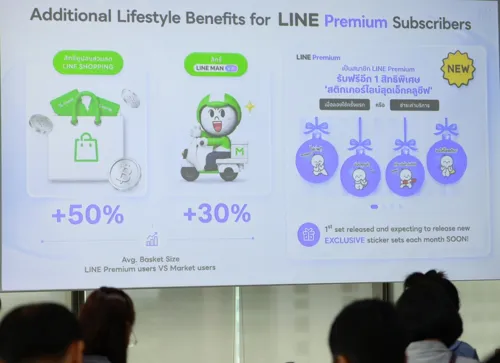
LINE Thailand unveiled its 2026 roadmap at a major business conference, introducing Chat Commerce Engine with AI-powered seller automation, customer data analytics, and ROBS measurement tools to help SMEs convert conversations into sales. The platform also launches MyTeam for team management and LINE MINI App ecosystem—with LINE MINI Eats already seeing 5x adoption growth in Q1 among cafes and F&B brands. For Thai SMEs relying on chat-based selling, these enterprise-grade features address key pain points: 90% of new chats go unresolved after first response, and accurate ROI measurement on broadcasts remains elusive.

 Stop running your company on Excel.