
Archive
August 13, 2026
▾ Hover for summary ▾ Tap for summary
Indonesia's president signals intent to launch domestic EV manufacturing by 2028, indicating regional shift toward electric vehicle production in Southeast Asia.

▾ Hover for summary ▾ Tap for summary
Thailand's Department of Intellectual Property is scaling up Geographical Indication (GI) protections as a tool to add value to local products across multiple regions. The article focuses on enforcing the "Lampang Chicken Bowl" GI designation (registered since 2011) and expanding new GI registrations for products like Ratchaburi limes, Betong oranges, Ko Kret red tea, and Nong Bua Lamphu silk. The enforcement clarifies that GI protection covers the use of specific names and official symbols, not product shapes; unauthorized use carries fines up to 200,000–400,000 baht or imprisonment. For SMEs and rural producers, this strengthens brand protection and market access in premium segments linked to heritage crafts and agriculture.
▾ Hover for summary ▾ Tap for summary
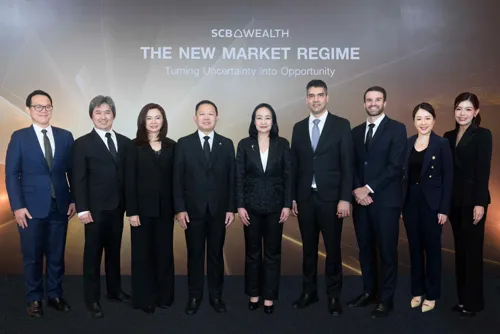
SCB WEALTH, in partnership with SCBAM, InnovestX, and global investment allies, launched the "One Smart Wealth" integrated wealth management strategy to help clients navigate market volatility. The approach uses a five-dimensional VAULT Framework (Value, Accumulation, Umbrella, Liquidity, Tactical) and incorporates insights from SCB CIO and BlackRock on AI concentration risk, diversification across value chains, and durable income strategies—positioning wealth management beyond pure returns toward life-goal alignment.

▾ Hover for summary ▾ Tap for summary
Lexus Thailand launches the new ES sedan with two powertrain options: a 2.5L hybrid ES350h (247 hp, 22.73 km/L) priced at 3.89 million baht, and a fully electric ES350e (224 hp, 620 km range, DC charging up to 150 kW) at 3.29 million baht. Built on the new GA-K platform supporting multi-pathway powertrains, the model features advanced tech (14-inch touchscreen with wireless CarPlay/Android Auto, 12.3-inch digital gauge, Mark Levinson audio), premium interiors, and Lexus Safety System +4.0. Launch offers include free maintenance packages and 5-year warranty.

 Empower businesses to thrive in the digital age.

▾ Hover for summary ▾ Tap for summary
Thailand faces ongoing monsoon rains and flooding risks across 12 high-risk provinces (mainly in the North and Northeast). Agriculture Ministry has ordered the Department of Water Resources to closely monitor water levels, accelerate repairs to critical drainage infrastructure including the Hatyai Canal in Songkhla (target: November 2025), and prepare emergency equipment and personnel. Current water storage is at 58% capacity, with rain forecast at 60-70% coverage through mid-August. This impacts agricultural operations and flood-prone communities nationwide.

▾ Hover for summary ▾ Tap for summary
Thailand's Department of Intellectual Property (DIP) has clarified that using generative AI to modify, remix, or create music from copyrighted songs without permission constitutes copyright infringement, even though Thai copyright law lacks specific AI provisions. Creators must verify copyright status and obtain permission before using others' work; public domain music may be used freely. The DIP offers mediation services and advises creators to consult before proceeding to avoid legal disputes.

▾ Hover for summary ▾ Tap for summary
Thailand's NESDC secretary clarified that the Wang Tond Reservoir project in Chachoengsao is not designed to supply data centers, but to ensure adequate water for agriculture, industry, and households. The government is accelerating large irrigation projects worth over 200 billion baht to address long-term flooding and water security in the Eastern Region, countering social media speculation linking the project to data center water demands.

▾ Hover for summary ▾ Tap for summary
GSMA warns that Thailand faces acute cyber threats from a growing "scam economy" powered by Generative AI and 5G, with 90% of fraud now rooted in social engineering and deepfakes. The organization advocates for telecom operators to deploy AI-driven detection, Open Gateway APIs for secure data sharing, and Verified Calling solutions as primary defenses. SMEs are urged to embed cybersecurity into core business policy, not treat it as IT-only; telcos will serve as the first line of defense through real-time spam filtering, SIM-swap detection, and cross-border threat intelligence sharing.
 Your real translator for LINE and Discord.

▾ Hover for summary ▾ Tap for summary
Thailand's government subsidy scheme "Thai Helps Thai Plus 60/40"—covering 60% of spending up to 200 baht/person/day or 1,000 baht/month—has successfully lifted consumer confidence for a second consecutive month, raising the index to 51.8 in July. The University of Thai Chamber of Commerce credits the programme, plus easing geopolitical tensions and declining oil prices, for the improvement. Despite gains across sub-indices (employment outlook up to 49.8, future income to 60.5), all remain below the neutral level of 100, signalling cautious optimism. The chamber expects confidence to accelerate noticeably from September into Q4 as the government accelerates budget disbursements and infrastructure investment, coinciding with peak tourism season. GDP growth is forecast at 2.0–2.5% for 2026.

▾ Hover for summary ▾ Tap for summary
Thailand's Ministry of Higher Education has launched a free "AI Thinking Framework" in partnership with LINE MAN Wongnai, a practical guide for working effectively with AI drawn from the company's real-world operations. The framework—covering when to use AI, how to think before prompting, and prioritizing understanding over quick answers—will be distributed nationally to students and the public as part of a broader initiative to build AI literacy across 20 million people and develop specialized talent like AI researchers and engineers. This public-private collaboration aims to prepare Thai workforce for future industries including agritech, health economy, and robotics.
▾ Hover for summary ▾ Tap for summary
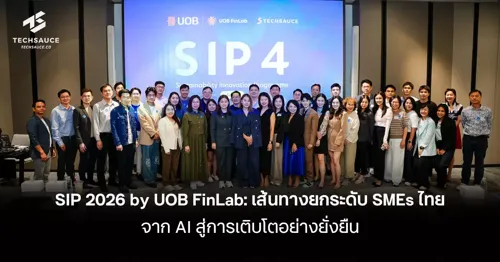
UOB FinLab launches SIP 2026, a year-4 initiative partnering with Techsauce to equip Thai SMEs with AI, sustainability, and data skills for long-term competitive growth. The program combines learning modules, hands-on AI tooling (Claude Cowork, data strategy), mentorship from industry leaders, and peer community-building across an intensive track culminating in actionable business plans and AI use-case deployments.

▾ Hover for summary ▾ Tap for summary
Y Combinator CEO argues that slow decision-making and bureaucratic friction within large corporations create competitive opportunities for agile AI startups. The insight is relevant for Thailand SME founders seeking to understand how startup agility can be a strategic advantage against established players. A useful perspective for aspiring entrepreneurs on positioning lean operations as a differentiator.

 Want to buy or sell a business?

▾ Hover for summary ▾ Tap for summary
Thailand's Interior Ministry has banned firearms as prizes for officials after public backlash over a shotgun raffle held days after a mass shooting. The government is implementing new gun-control measures including a moratorium on new gun permits, suspension of a "welfare guns" programme, and development of a tech-enabled firearms tracking system within 60 days. This policy shift reflects heightened focus on reducing firearms circulation and improving accountability.

▾ Hover for summary ▾ Tap for summary
This article argues that taking intentional breaks and mental downtime improves productivity and prevents burnout, not the opposite. Drawing on neuroscience concepts like the Default Mode Network, it explains how mental rest allows the brain to process information, solve problems, and generate ideas more effectively than constant effort. Practical recommendations include short breaks during the workday—eating without checking email, sitting quietly, or simply disconnecting—rather than waiting for all work to finish before resting.

▾ Hover for summary ▾ Tap for summary
Prachathai Business is hosting a major annual seminar on "Beyond ESG: Thailand Transition" to position ESG beyond compliance—as a structural transformation strategy for competitive advantage and sustainable growth. The event brings policymakers, government, private sector leaders, and experts to address how Thailand can transition toward a high-income economy within 12 years, with energy, environment, AI, and human capital as new competitiveness drivers. Capital will increasingly flow to businesses that create value and prove sustainability, making this transition imperative for Thai enterprises and the nation's future.

▾ Hover for summary ▾ Tap for summary
Lenovo reported a 43% revenue surge driven by strong demand for AI and PC products, though the company faces headwinds from rising memory chip costs that impacted Q4 profitability. For Thai SMEs evaluating tech supply chains or considering device refreshes, this signals continued strong pricing power in AI-capable hardware but warns of potential cost pressures ahead.
 Together GoWeGo! Ferry tickets in Thailand.

▾ Hover for summary ▾ Tap for summary
Japanese life insurers face mounting unrealized losses (¥9.6 trillion) on legacy government bonds as rates rise, with surrender payouts jumping 40% in H1 2026. However, this reflects portfolio reallocation rather than liquidity crisis: Japanese policyholders are rationally shifting to higher-yielding assets and competing products as rate cycles shift. Thailand remains insulated from similar pressures—the phenomenon will only materialize if Thai rates rise significantly. Key risk signal: forced bond sales if surrenders spike abnormally alongside continued rate hikes.

▾ Hover for summary ▾ Tap for summary
Thailand's Energy Regulatory Commission (ERC) has approved a new progressive electricity rate structure for residential users, effective September 2026. The first 200 units will be capped at no more than 3 baht/unit, while higher consumption tiers see modest rate reductions (201–400 units: 4.16 baht/unit; 401+ units: 4.36 baht/unit). The weighted average residential rate drops from 3.95 to 3.86 baht/unit. The policy also expands eligibility to include unregistered residential properties with consistent 6+ months payment history. This directly affects household budgets and operating costs for any SME running residential spaces, as well as fixed-cost planning for utilities.
▾ Hover for summary ▾ Tap for summary
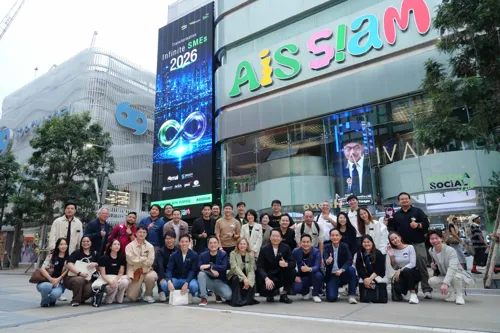
AIS launches Transformative Infinite SMEs 2026, a strategic initiative positioning digital infrastructure as foundational support for Thai software and tech SMEs. The program introduces the "3 Connections" model—connecting technology (AIS Cloud X, AI tools), market access (51M+ AIS customers), and talent—to help entrepreneurs transition from customized development and SaaS toward AI-native, outcome-based business models. This targets a key gap: elevating Thai software firms from service contractors to IP-driven innovators competitive globally, aligning with the 5.6 trillion baht Digital GDP opportunity.

▾ Hover for summary ▾ Tap for summary
OpenClaw's founder discusses the risks and challenges AI startups face when their products go viral, highlighting how rapid growth and public scrutiny can create operational and reputational pressures that threaten startup survival.

 Stop running your company on Excel.