
Archive
August 13, 2026

▾ Hover for summary ▾ Tap for summary
This article argues that taking intentional breaks and mental downtime improves productivity and prevents burnout, not the opposite. Drawing on neuroscience concepts like the Default Mode Network, it explains how mental rest allows the brain to process information, solve problems, and generate ideas more effectively than constant effort. Practical recommendations include short breaks during the workday—eating without checking email, sitting quietly, or simply disconnecting—rather than waiting for all work to finish before resting.

▾ Hover for summary ▾ Tap for summary
Prachathai Business is hosting a major annual seminar on "Beyond ESG: Thailand Transition" to position ESG beyond compliance—as a structural transformation strategy for competitive advantage and sustainable growth. The event brings policymakers, government, private sector leaders, and experts to address how Thailand can transition toward a high-income economy within 12 years, with energy, environment, AI, and human capital as new competitiveness drivers. Capital will increasingly flow to businesses that create value and prove sustainability, making this transition imperative for Thai enterprises and the nation's future.

▾ Hover for summary ▾ Tap for summary
Lenovo reported a 43% revenue surge driven by strong demand for AI and PC products, though the company faces headwinds from rising memory chip costs that impacted Q4 profitability. For Thai SMEs evaluating tech supply chains or considering device refreshes, this signals continued strong pricing power in AI-capable hardware but warns of potential cost pressures ahead.

▾ Hover for summary ▾ Tap for summary
Japanese life insurers face mounting unrealized losses (¥9.6 trillion) on legacy government bonds as rates rise, with surrender payouts jumping 40% in H1 2026. However, this reflects portfolio reallocation rather than liquidity crisis: Japanese policyholders are rationally shifting to higher-yielding assets and competing products as rate cycles shift. Thailand remains insulated from similar pressures—the phenomenon will only materialize if Thai rates rise significantly. Key risk signal: forced bond sales if surrenders spike abnormally alongside continued rate hikes.

 Empower businesses to thrive in the digital age.
▾ Hover for summary ▾ Tap for summary
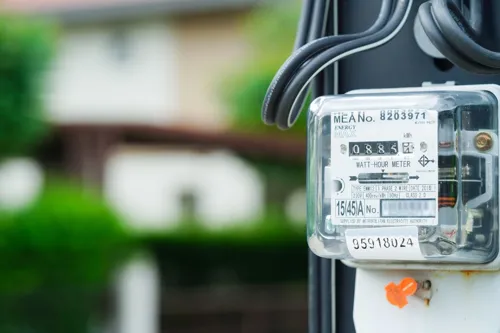
Thailand's Energy Regulatory Commission (ERC) has approved a new progressive electricity rate structure for residential users, effective September 2026. The first 200 units will be capped at no more than 3 baht/unit, while higher consumption tiers see modest rate reductions (201–400 units: 4.16 baht/unit; 401+ units: 4.36 baht/unit). The weighted average residential rate drops from 3.95 to 3.86 baht/unit. The policy also expands eligibility to include unregistered residential properties with consistent 6+ months payment history. This directly affects household budgets and operating costs for any SME running residential spaces, as well as fixed-cost planning for utilities.
▾ Hover for summary ▾ Tap for summary
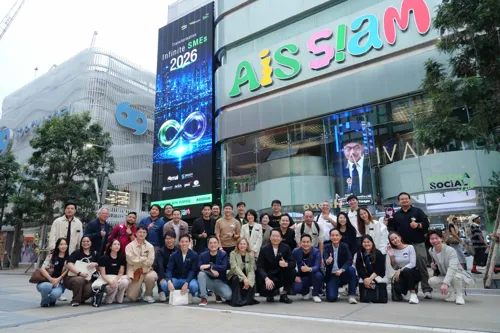
AIS launches Transformative Infinite SMEs 2026, a strategic initiative positioning digital infrastructure as foundational support for Thai software and tech SMEs. The program introduces the "3 Connections" model—connecting technology (AIS Cloud X, AI tools), market access (51M+ AIS customers), and talent—to help entrepreneurs transition from customized development and SaaS toward AI-native, outcome-based business models. This targets a key gap: elevating Thai software firms from service contractors to IP-driven innovators competitive globally, aligning with the 5.6 trillion baht Digital GDP opportunity.

▾ Hover for summary ▾ Tap for summary
OpenClaw's founder discusses the risks and challenges AI startups face when their products go viral, highlighting how rapid growth and public scrutiny can create operational and reputational pressures that threaten startup survival.
▾ Hover for summary ▾ Tap for summary
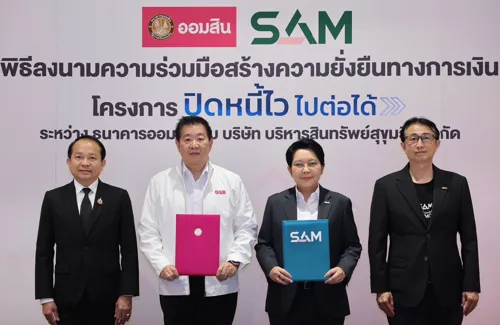
Thailand's Government Savings Bank (Ommsin) and SAM asset management company signed an MOU to launch a "Financial Sustainability Collaboration Project" aimed at helping debtors develop financial literacy and money management skills. The program provides qualifying participants with access to credit facilities to start businesses or improve cash flow, helping them transition from debt assistance to genuine financial recovery and economic reintegration. This partnership shifts focus from relief to opportunity creation through financial training via Ommsin's mobile app.
 Your real translator for LINE and Discord.

▾ Hover for summary ▾ Tap for summary
Environmental conservationist Sassin Chiemmalaph argues that the Wang Tong reservoir project's environmental impact assessment (EHIA) missed a critical middle ground: reducing the reservoir capacity from the planned 99.5 million cubic meters to 60–80 million cubic meters could maintain adequate water supply while minimizing forest damage. He contends the dam is feasible if recalibrated to balance water needs with habitat preservation, since Chanthaburi's high rainfall allows continuous water replenishment even at lower storage levels. The core failure of EHIA, he says, was asking "how to mitigate impact after construction" instead of "how to redesign to prevent impact from the start."
▾ Hover for summary ▾ Tap for summary
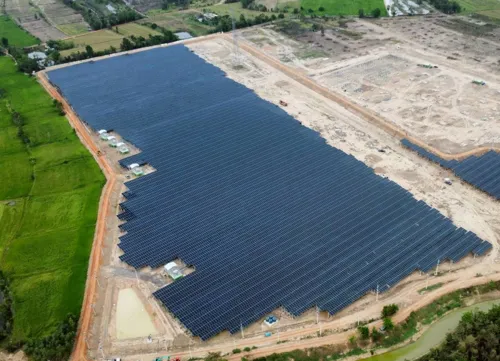
ACE, Thailand's clean energy leader, reported Q2 2025 net profit of 278.7 million baht, up 87.3% YoY, driven by significant gross profit growth from both solar and waste-to-energy power plants. Revenue grew 7.8% to 1,765 million baht. ACE is accelerating development of 92 clean energy projects (767.42 MW capacity) with 47 operational and 45 under development, targeting multiple COD completions in 2026. The company also won auctions for a new 9.9 MW waste-to-energy plant in Nakhon Phanom. Financial costs fell 21.9%, strengthening bottom-line performance.
▾ Hover for summary ▾ Tap for summary
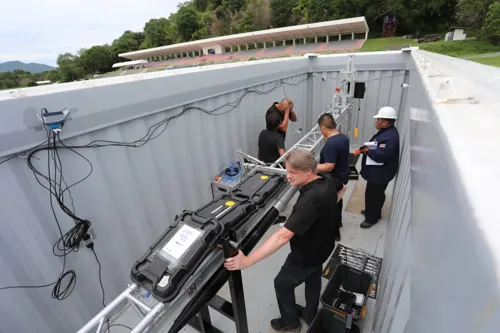
Thailand conducted its first private-sector rocket test under a Spaceport Regulatory Sandbox framework, a government-private-military collaboration involving GISTDA and Equatorial Space. Despite technical failures preventing liftoff—including nitrous oxide temperature control and communication signal loss—the test succeeded in validating regulatory systems, safety protocols, and airspace management. The initiative aims to establish a domestic space economy spanning transport, insurance, and manufacturing, positioning Thailand as a regional space industry hub.

▾ Hover for summary ▾ Tap for summary
The article challenges the common misconception that exhaustion is solved by passive rest alone. It argues that human energy functions like a machine requiring proper maintenance, movement, and motivation—not a smartphone battery that simply needs charging. Key insight: inactivity can paradoxically deepen fatigue by reducing bodily efficiency, and mental factors like dopamine and genuine stress-relief (not pseudo-rest while checking work emails) are critical to real energy recovery. Relevant for working professionals seeking sustainable wellness practices.

 Want to buy or sell a business?

▾ Hover for summary ▾ Tap for summary
SCAP (Sri Suwardi Capital), a leading micro-credit provider, reported H1 2026 net profit of 898.12 million baht, up 146% YoY, with total revenue of 2.92 billion baht. Growth driven by flagship motorcycle lease-purchase and expanding locked-phone credit business across 7,000+ retailers with partnerships including Xiaomi, Realme, and Huawei. Automated credit approval system launched July 2026 increased customer acquisitions by 40% and expanded reach to all districts nationwide. Management expects consecutive record profits throughout 2026.
▾ Hover for summary ▾ Tap for summary
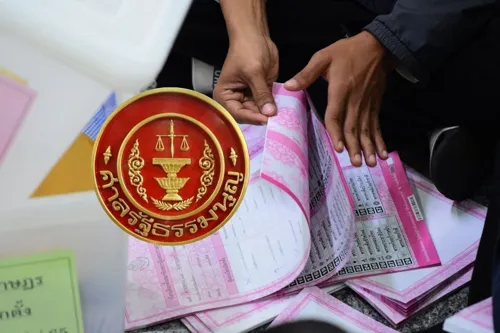
Thailand's Constitutional Court has scheduled witness testimony for 26 August 2026 in a high-profile case challenging the legality of barcode and QR code usage on 2026 election ballots. The Ombudsman argues the codes violated ballot secrecy constitutional guarantees. This case directly affects electoral integrity and may influence future voting systems, though limited to a specific procedural hearing with no live broadcast permitted.

▾ Hover for summary ▾ Tap for summary
Thailand's Deputy PM Ekniti identifies four major challenges driving economic transformation: geopolitical polarization (US-China trade barriers), AI technology adoption, environmental transition, and labor shortage from aging society. Thailand must balance neutrality while attracting quality investment, democratize AI access, transition energy sources (currently 65% imported), and prepare courts for emerging case types including forced labor, environmental crimes, and AI-facilitated fraud.
▾ Hover for summary ▾ Tap for summary
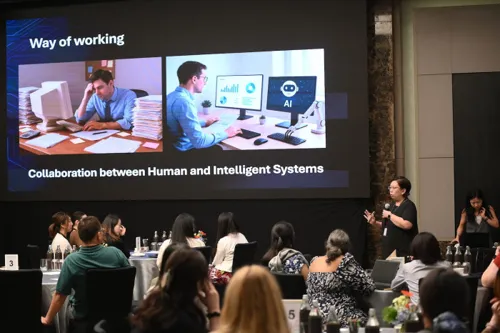
AI training completion alone doesn't drive real adoption—Thai businesses and SMEs investing in upskilling must embed AI into workflows, leadership behavior, and performance metrics to see meaningful results. The article argues that leaders must visibly model AI use, allow safe practice on live work, and redesign how performance is evaluated; training without systemic reinforcement becomes merely decorative.
 Together GoWeGo! Ferry tickets in Thailand.

▾ Hover for summary ▾ Tap for summary
Thumbsup identifies 7 key mistakes in short-form video production that cause viewer drop-off: weak opening hooks within 3 seconds, verbose introductions, static camera work, missing or poorly-formatted subtitles, and others. The article emphasizes that retention and views depend more on content structure than algorithm luck, offering practical fixes like dynamic framing, B-roll layering, and proper subtitle placement—critical for Thailand's rapidly growing TikTok/Reels-native SME marketers.
▾ Hover for summary ▾ Tap for summary
Thailand's Q2 GDP growth is expected to decelerate significantly due to weak consumer spending, which could signal softer economic conditions ahead for SMEs and businesses dependent on domestic demand.

▾ Hover for summary ▾ Tap for summary
Agent AI—autonomous AI-powered attack tools—represent a critical emerging threat to Thailand's financial sector and SMEs. Attack success rates have jumped from 20% to over 90%, and time to compromise has collapsed from 4 months (2023) to 12-22 hours (2026). The financial sector is mobilizing through TB-CERT to coordinate cross-institutional cybersecurity response. Over 200 million Thai login credentials have already leaked to the dark web, making immediate adoption of AI-aware security protocols and sector-wide collaboration essential for business survival.

▾ Hover for summary ▾ Tap for summary
Google DeepMind has released SL2T, an AI model that translates sign language directly to text in real-time, now available on Pixel 11 phones via Gboard and Live Transcribe. Trained on 100,000+ hours of sign language data across 50+ languages, SL2T uses computer vision to track full-body movements and employs machine translation rather than word-by-word conversion—addressing the 70 million deaf and hard-of-hearing users globally. The breakthrough ditches earlier flawed glossing approaches and on-device processing keeps raw video private.

 Stop running your company on Excel.