
Archive
September 9, 2026
▾ Hover for summary ▾ Tap for summary
NEXTDC, an Australian data centre operator, is raising $795 million to expand AI infrastructure capacity in the region.
▾ Hover for summary ▾ Tap for summary
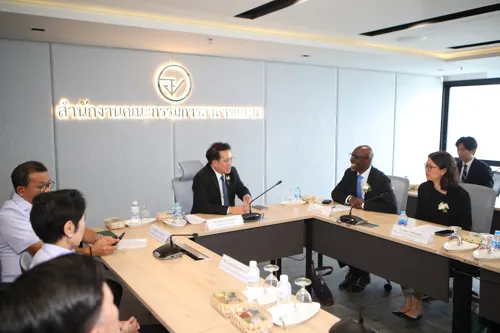
Thailand's Ministry of Public Health and MSD signed an MOU to advance the Medical Investment Hub policy across three pillars: medical service excellence, clinical research & development, and pharmaceutical/vaccine manufacturing. The initiative targets 0.5%+ GDP value addition, new foreign investment, and improving Thailand's health-competitiveness ranking from 56th to top 50 globally. Key focus areas include vaccine access (HPV, PCV), clinical research capacity building (targeting 2.5B baht investment by 2027), and voluntary licensing for HIV PrEP production domestically—signaling pragmatic public-private collaboration on health security and bioeconomy growth.

▾ Hover for summary ▾ Tap for summary
Thailand's government is launching a solar rooftop subsidy scheme in mid-October, offering 50,000 baht per household installation with a target of 1–1.5 million households. The 50 billion baht programme, funded from energy transition budget, aims to convert consumers into producers—households can earn ~1,000 baht/month selling surplus power to utilities over 25–30 years. State banks will finance installations, with electricity sales revenue covering repayments, requiring minimal household upfront investment. The initiative addresses rising energy costs, supports domestic industry, and creates jobs while reducing import dependence on LNG.

▾ Hover for summary ▾ Tap for summary
Gen Z is reshaping Thai business on two fronts: as consumers who rely on TikTok/social media (66.9%) rather than Google (21.9%) for purchase decisions, and as talent with high expectations for workplace culture and meaning—56% plan to stay only 1–2 years. The article advocates "reverse mentoring" where Gen Z teach leadership, while older executives focus on strategy. Retention hinges less on salary and more on mission alignment and growth; Gen Z prioritize value-for-money and purpose over traditional obedience, forcing organizations to rethink talent strategy.

 Empower businesses to thrive in the digital age.

▾ Hover for summary ▾ Tap for summary
Thailand's Central Bank Governor revealed a critical SME crisis: 50% of registered SMEs fail within 10 years, SME contribution to GDP has dropped from 1.9% to 1.3%, non-performing loans hit 9.5% (vs. 2% for large firms), and rejection rates reach 55–70%+ for credit applications. Zombie SMEs unable to cover interest jumped from 2% to nearly 6%. The Bank of Thailand is launching a three-pillar SME Credit Ecosystem (portal, new guarantee mechanism, data bureau) to reduce access costs and credit risk, targeting 200,000 million baht in combined credit guarantees annually.

▾ Hover for summary ▾ Tap for summary
OpenAI and Samsung are strengthening their partnership on next-generation chip development and AI integration. While details are limited, this represents a significant industry move combining OpenAI's AI expertise with Samsung's semiconductor manufacturing capabilities, relevant for Thai tech companies tracking global AI infrastructure trends.

▾ Hover for summary ▾ Tap for summary
OpenAI has solved part C of the Navier-Stokes Millennium Prize Problem—one of seven unsolved mathematical challenges worth $1 million each. Using swarms of AI agents, they proved that smooth fluids can develop singularities (infinite velocity) in finite time under smooth forcing, answering a 90-year-old question. This breakthrough demonstrates multi-agent AI collaboration and has implications for understanding fluid dynamics across aerospace, weather prediction, and medicine—though the full prize still requires solving other sub-problems.

▾ Hover for summary ▾ Tap for summary
Indonesian AI infrastructure startup Zankore has secured a $3.1 billion loan, signaling major investment in Southeast Asia's AI compute capacity. While directly an Indonesia story, it reflects regional AI infrastructure trends that may affect Thailand's competitive position in the AI/tech ecosystem.
 Your real translator for LINE and Discord.

▾ Hover for summary ▾ Tap for summary
The Bank of Thailand (BoT) has identified a critical SME credit access crisis, with rejection rates reaching 60-70% overall and up to 90% for new/risky borrowers. The central bank plans three support measures to push SME lending to 200 billion baht annually, addressing structural economic issues including stalled GDP growth (2.3% forecast for 2025 vs. 3-4% potential), declining SME contribution to growth, and persistent financial inequality. High interest rates (6.9% for SMEs vs. 3.9% for large firms) and credit cost barriers are key obstacles.

▾ Hover for summary ▾ Tap for summary
Sansiri launches "The Base Midtown – Phuket" (1.1B THB, 394 units) targeting working professionals and investors with 9–11% rental yields, and jointly develops "Canvas Palette Beachfront" (1.9B THB, 248 units) with Four P Holdings as a wellness-focused luxury condo partnering with Bumrungrad International Hospital. Both projects start presales this month, expanding Sansiri's Phuket footprint to 8+ projects and positioning the developer for long-stay and high-end tourism segments.

▾ Hover for summary ▾ Tap for summary
CMDF has completed research on optimal Thai broker industry structure aligned with Thai capital market size, and will submit findings to SEC and SET for further review. The organization has also invested 400+ million baht across 63 policy research projects over 6 years, including key initiatives like TISA (tax-advantaged personal investment accounts) and the JUMP+ program supporting 142 listed companies. Clarity on TISA format expected by year-end; results from JUMP+ should show measurable impact within 3-5 years.
▾ Hover for summary ▾ Tap for summary
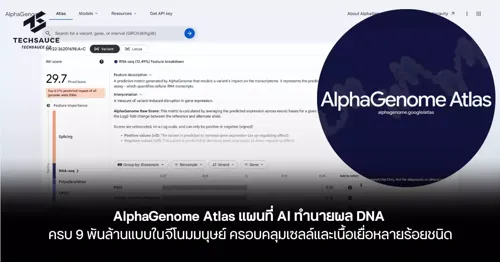
Google DeepMind launched AlphaGenome Atlas, a searchable database with AI-predicted effects of all 9 billion possible single DNA mutations on human genes across hundreds of cell types. The Atlas combines two models—AlphaGenome (predicting regulatory effects) and AlphaMissense (predicting protein changes)—into a single Impact Score (AVI) that works on both protein-coding and non-coding regions (98% of the genome). This breakthrough compresses impractical lab experimentation into instant lookups, accelerating genetic research and rare disease diagnosis; researchers can now explore comprehensive genomic variants via a web browser, already demonstrating utility in identifying causal mutations in rare disease cases.

 Want to buy or sell a business?

▾ Hover for summary ▾ Tap for summary
Bitkub officially launched KUB Wallet v2 at KUB Global Bangkok 2026, designed to simplify Web3 adoption for everyday users. Key features include simplified asset transfers via phone number/QR code, multi-chain support (KUB Chain, Ethereum, Arbitrum, Base, BSC), partnership with Ondo for tokenized global stocks, WalletConnect integration, and a new "KUB Prime" rewards program where user activities earn redeemable KUB GEM points. The wallet also integrates KUB Chain ecosystem apps and supports THBK stablecoin, positioning it as a bridge between traditional finance and on-chain accessibility for Thai SMEs and retail users.

▾ Hover for summary ▾ Tap for summary
OpenAI is making AI testing more affordable, which could enable researchers and organizations with limited budgets to conduct experiments and revive previously unfeasible research projects. This development has potential implications for innovation accessibility in emerging markets and SMEs exploring AI applications.

▾ Hover for summary ▾ Tap for summary
Khon Kaen city is positioning itself as the northeast's digital hub by attracting data centers and aircraft maintenance/repair (MRO) facilities, leveraging existing logistics infrastructure including the Friendship Highway, rail networks, and planned China-Thailand high-speed rail. The province is simultaneously pursuing Eco-City development with 22 public-private stakeholders to address waste management and carbon emissions, while maintaining diversified manufacturing (sugar, rubber, textiles, automotive parts, biotech). This positions SMEs to benefit from infrastructure upgrades, but success depends on government budget support and private sector technology adoption.

▾ Hover for summary ▾ Tap for summary
Thai organizations struggle with AI adoption: 61% use AI partially but fall short of expectations, with only 10% succeeding as planned. Key barriers are lack of skilled talent (71%), unclear use cases, and unready data/infrastructure. AIS demonstrates pragmatic implementation by embedding AI into core operations—autonomous network management and AI-powered call centers—showing measurable ROI and shifting AI from assistant tool to integral business process. The article outlines a maturity framework: AI as tool → AI in application → AI as core process, emphasizing that success requires clear business impact, trustworthiness, cost efficiency, and scalability.
 Together GoWeGo! Ferry tickets in Thailand.
▾ Hover for summary ▾ Tap for summary
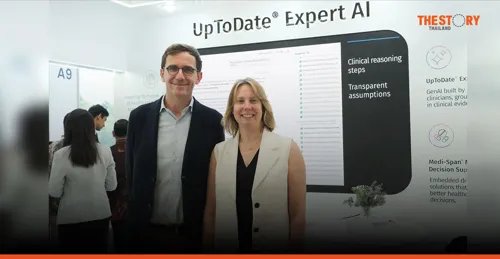
Wolters Kluwer Health's UpToDate Expert AI addresses a critical challenge in medical AI: preventing hallucination by tethering LLM responses to verified medical knowledge rather than allowing the model to generate answers from its internal parameters. With 200+ Thai hospitals and medical schools already using UpToDate, and 25+ medical schools now piloting UpToDate Expert AI, Thailand is adopting clinical decision support tools faster than most Asian peers. The strategy focuses on medical education first, where AI aids research without diminishing clinical reasoning, before broader hospital rollout—a prudent approach given stricter governance requirements in clinical care.

▾ Hover for summary ▾ Tap for summary
A civil society network released data on 11 aquaculture/export firms that shipped over 320,000 black-spotted pufferfish (2013–2016), before a 2017 outbreak. They're pressing the state to tighten traceability systems and investigate how such misclassifications occurred over 200+ shipments. An administrative court issued a 180-day deadline for containment, rehabilitation, and enhanced aquatic-animal oversight to prevent future invasions and ecological damage in affected areas.

▾ Hover for summary ▾ Tap for summary
Deputy PM Ekniti outlined a two-part economic strategy: (1) "Repair" phase includes debt relief programs for small business (1M households via Phit Hai Jai Pai Toh Dai scheme), SME supply chain financing, and state welfare support; (2) "Build" phase targets AI, clean energy (50k baht household solar subsidies), semiconductor manufacturing, and elderly care sectors. Thailand must capitalize on global supply chain shifts from geopolitical tensions and AI boom to shift from recession (A-shape) to recovery (V-shape), while preventing widening inequality (K-shape divide).

▾ Hover for summary ▾ Tap for summary
Kumamoto Airport (operated by Kyushu Kumamoto International Airport Co.) plans to launch direct routes to Southeast Asia, with Thailand's Bangkok as the first destination by end of fiscal 2030. The airport aims to grow international passenger volume by 40% to 920,000 by FY2029, driven by its proximity to TSMC and Sony manufacturing hubs. New infrastructure including bonded warehouses supports semiconductor cargo logistics. For Thai SMEs and tourism operators, this creates export/import opportunities and stronger bilateral air connectivity with Japan's Kyushu region.

 Stop running your company on Excel.