
Archive
September 11, 2026

▾ Hover for summary ▾ Tap for summary
Thailand's Egat has launched a five-phase roadmap to deploy small modular reactors (SMRs), with the first 300-MW unit targeting commercial operation by 2037. This strategic energy initiative supports Thailand's net-zero transition, carbon-free power generation, and industrial growth. Egat is already reviewing leading SMR technologies from the US, China, Russia, and Canada, with cabinet approval pending for procurement. Success depends on establishing a nuclear energy implementation body and securing community acceptance.

▾ Hover for summary ▾ Tap for summary
Thai authorities plan to introduce additional debt restructuring measures for mortgage borrowers facing weakened debt-servicing capacity due to slower economic growth. Housing demand has fallen to a four-year low with only 35% of survey respondents planning home purchases within five years, while higher-income earners (100,000+ baht/month) show the greatest reluctance to buy, reflecting persistent economic headwinds and elevated home prices that deter consumer spending.

▾ Hover for summary ▾ Tap for summary
Thai authorities are rolling out additional debt restructuring measures for mortgage borrowers as economic growth slows and household debt-servicing capacity weakens. Consumer demand for housing has declined to a 4-year low, with 65% of survey respondents showing no plans to buy a home within 5 years. Tightened lending criteria and elevated household debt remain major barriers to mortgage access, particularly for mid-to-lower-income segments earning under 100,000 baht monthly.

▾ Hover for summary ▾ Tap for summary
Thailand's Tourism and Sports Ministry is pushing the "Thai Travel Plus" stimulus scheme to cabinet vote on September 22, expecting it to drive 20 billion baht in economic activity. The scheme targets domestic tourism recovery and represents moderate policy momentum, though full details remain behind a paywall and the actual SME/tech impact isn't explicitly clear from the available snippet.

 Empower businesses to thrive in the digital age.

▾ Hover for summary ▾ Tap for summary
The Prime Minister has directed the State Railway of Thailand to urgently fix operational problems with the Airport Rail Link and maintain continuous service. A critical contract with Asia One Era (subsidiary of CP Group) expires Sept 30, with concerns about service continuity. The operator has agreed in principle to keep trains running, pending contractual amendments and supervisory committee review. This affects airport access and transport infrastructure reliability for businesses and travelers.

▾ Hover for summary ▾ Tap for summary
Thailand expects 250,000 Chinese tourists during Sept 25–Oct 7, coinciding with Golden Week and Mid-Autumn Festival, to generate 11.5 billion baht in revenue. New direct flights between Bangkok, Xiamen, and Shanghai, combined with a weak baht (down ~10% YoY against the yuan), are making Thailand a competitive destination. Year-on-year Chinese visitor growth is up 24%, but TAT acknowledges ongoing challenges in competing for longer-haul trips to destinations like Brazil and Portugal.

▾ Hover for summary ▾ Tap for summary
Thailand's auto industry is pushing for clearer government guidelines on the new three-tier EV excise tax structure designed to incentivize domestic manufacturing and local content. The EB Board recently approved differentiated rates (2% for promoted domestic plants, 8% for non-promoted, 10% for imports), but automakers and SME suppliers need urgent clarification on local-content thresholds, import volumes, and privileging to plan production and investment effectively. Delays in detailed implementation could stall industry investments.

▾ Hover for summary ▾ Tap for summary
Thailand's automotive sector is seeking clarity on a new three-tier EV tax structure (2%, 8%, 10%) designed to encourage domestic production and benefit SMEs and local parts suppliers. The government and industry are working together to refine key details—including local content requirements and import limits—to ensure fair competition, transparency, and investment security for manufacturers planning production and sales strategies in Thailand.
 Your real translator for LINE and Discord.

▾ Hover for summary ▾ Tap for summary
TrueID's TATANG platform has partnered with COL Group, a global vertical series leader, to develop Thai creative talent and creators through curriculum incorporating AI technology and international production standards. The collaboration will bring 260+ vertical series (live-action and AI-generated content) from FlareFlow with Thai dubbing to Thai audiences via TATANG, positioning it as a key hub for Thailand's vertical content ecosystem connecting creators, content, and consumers across the True and CP Group networks.
▾ Hover for summary ▾ Tap for summary
Geopolitical tensions and shipping attacks in disputed waters are driving up maritime transport costs, which could increase input costs for Thai exporters and manufacturers relying on energy imports.
▾ Hover for summary ▾ Tap for summary
Bangkok Metropolitan Government has signed an executive order establishing "Open by Default" as its data disclosure principle—marking the first Thai public agency to formally adopt this approach. The order mandates that all BMA units, subcontractors, and even commercial enterprises like Bangkok Bank must proactively publish data in machine-readable digital formats, reversing the traditional "request-to-access" model. Critical areas like budget, procurement, and revenue details are prioritized for immediate digital release, with 30-day deadlines and six-monthly progress tracking. This serves as a potential nationwide template for other Thai government agencies to follow.

▾ Hover for summary ▾ Tap for summary
U.S. Core CPI rose 0.3% month-over-month in August (above market expectations of 0.2%), driven largely by gasoline prices. This data has increased market odds to ~90% for a U.S. Federal Reserve rate hike at the September 15–16 meeting. While equity futures (S&P 500) remain resilient, rising bond yields reflect inflation concerns. For Thailand SMEs with USD exposure or importing costs, this signals ongoing U.S. monetary tightening that could affect exchange rates and input prices.

 Want to buy or sell a business?

▾ Hover for summary ▾ Tap for summary
Thailand's Revenue Department reported tax collections of 2.16 trillion baht through August, up 7.2% YoY, and projects exceeding its 2.44 trillion baht annual target by ~2% (40-50 billion baht overage). Key drivers include higher import VAT (9.8% above budget) and corporate tax revenue from energy companies benefiting from rising global oil prices. The department also deployed data analytics and online platform integration to expand the taxpayer base by 170,000 new registrations, including 56,000 online merchants, signaling improved compliance especially among younger entrepreneurs preparing for capital market listings. FY2570 target set at 2.5 trillion baht.

▾ Hover for summary ▾ Tap for summary
Thailand's EV Board approved a new excise tax structure (effective 2026) that penalizes imported EVs with no local manufacturing while rewarding companies producing in Thailand and using domestic parts with lower tax rates. The model targets local manufacturing value-add across investment, production, components, and jobs. Current momentum is strong: BEV registrations rose 88% in H1 2026, xEV vehicles hit 55% of all new car sales, and BOI has approved 189 EV-related projects worth 151 billion baht. Major automakers (Mitsubishi, Honda, Mazda, Isuzu) are adding 50+ billion baht in capex to modernize production.

▾ Hover for summary ▾ Tap for summary
Two senior DSI officials were arrested for allegedly soliciting 55 million baht from 700 job applicants in exchange for securing civil service positions. The scheme involved claiming access to position quotas and rigging recruitment exams. This is part of a larger corruption network that has resulted in the dismissal of 3,868 employees hired fraudulently, with bribes reportedly ranging from 350,000 to 800,000 baht per position.

▾ Hover for summary ▾ Tap for summary
Chiang Mai Municipality launched "Chiang Mai City Gallery @ Chang Moi," a street art initiative revitalizing the historic Chang Moi quarter through community-led public art projects. The program aims to boost grassroots creative economy by documenting the neighborhood's heritage (trade history, elephant imagery) on murals, attract art-focused tourists, and serve as a replicable model for sustainable neighborhood development. Key: emphasis on community participation ("co-think, co-do") to balance tourism with residents' livelihoods, including support for local goods (chili paste, handicrafts).
 Together GoWeGo! Ferry tickets in Thailand.

▾ Hover for summary ▾ Tap for summary
Trat Chamber of Commerce, the Foundation for Business and Community Leadership Development (BCL), and Plearn Pattana School are launching a 3-year educational development initiative across 6 pilot schools in Trat Province. The "Trat Model" aims to build human capital by developing students' knowledge, skills, mindset, ethics, and social responsibility—positioning education as "everyone's business" and creating a bridge between schools, businesses, and communities to sustain the province's economic future.

▾ Hover for summary ▾ Tap for summary
The Revenue Department will audit Wat Phutthaisawan foundation income and meet with the National Buddhism Office on September 22 to tighten e-Donation system controls following recent money-laundering allegations. As of January 1, 2025, all charitable organizations must use e-Donation for tax-deductible donations. Currently ~43,000 temples are registered (99% of Thailand's ~45,000 temples), with 23 billion baht accumulated in 2025 donations. The move aims to increase transparency and ensure proper tax compliance for religious institutions.
▾ Hover for summary ▾ Tap for summary
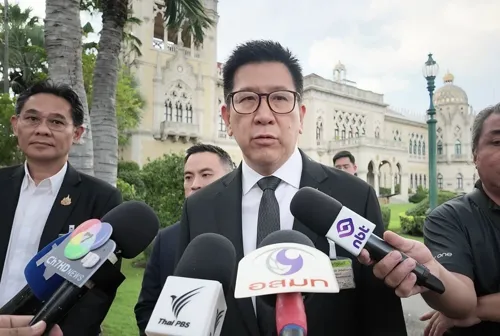
Thailand's government is implementing comprehensive new regulations for data centres, with a key requirement that facilities cannot be located in city centres. Deputy PM Ekniti reported that inter-agency task forces have been assigned to establish minimum standards across economic, social, and environmental dimensions within one month, including stricter electricity pricing for data centre operators and mandatory EIA compliance. This regulatory overhaul aims to address previous loopholes, with only 3 BOI-approved data centres currently in Bangkok.

▾ Hover for summary ▾ Tap for summary
Thailand's rising public debt poses systemic risks to investment portfolios beyond direct government bond exposure. The article identifies five transmission channels: rising bond yields compress valuations of interest-rate-sensitive stocks; higher government borrowing costs force corporates to refinance at higher rates, pressuring earnings and cash flow; fiscal constraints reduce economic stimulus and public spending; capital outflows weaken the baht; and bond volatility cascades through banking and fund valuations. SMEs with leveraged balance sheets or revenue dependent on public spending face elevated refinancing and demand risks.

 Stop running your company on Excel.