
Archive
August 10, 2026

▾ Hover for summary ▾ Tap for summary
Central Pattana reported Q2/2025 revenue of 13.1 billion baht (+8% YoY) and net profit of 4.75 billion baht (+10% YoY), marking four consecutive quarters of new revenue highs. Key growth drivers include new shopping centre launches (Central Khon Kaen Campus and Central Northville), 100% sell-out of Phyll Khon Kaen residential project (1.6 billion baht), and expanded office leasing at Central Park Offices. The company now operates 45 shopping centres, 16 community malls, and 52 residential projects across Thailand and Malaysia, with a record dividend payout of 2.40 baht per share from FY2024 results.

▾ Hover for summary ▾ Tap for summary
Kubota Thailand reports new machinery sales fell 1H 2025 for the first time in years, as farmers shift to repair/maintenance due to economic pressure and rising input costs. The company is leveraging AI-powered telematics, a 820k-unit database, and a 308-team field network to transform after-sales into proactive service—aiming for same-day parts delivery and 1-day repairs during critical harvest season (Oct–Dec). Customer satisfaction stands at 97.8%, positioning after-sales as a strategic retention tool when new equipment demand stalls.

▾ Hover for summary ▾ Tap for summary
Thailand faces a 12.5% additional tariff under US Section 301 forced labor rules—2.5% higher than Ecuador and Indonesia. Thai tuna (29.7% US market share) is well-positioned to absorb the cost difference due to strong processing infrastructure, but Thai shrimp (4.5% market share) faces acute pressure as it competes on price against lower-tariffed rivals. The Fisheries Department is rolling out five counter-measures, including import controls for forced-labor-risk products and cost-structure reforms, to shore up competitiveness and prevent labor issues from becoming a lasting trade barrier.

▾ Hover for summary ▾ Tap for summary
This article presents Sean Jacobsohn's "Six Forces of Failure" framework, derived from analyzing 1,000+ failed products from global brands (Amazon Dash, Apple Newton, Sony Betamax, BlackBerry). The six failure factors are: poor product-market fit, fragile financial structure, ignoring customer needs, intense competitive traps, misaligned organizational culture, and inadequate execution. Thai SME founders and marketers should study this framework to avoid repeating costly mistakes in product development and market entry.

 Empower businesses to thrive in the digital age.

▾ Hover for summary ▾ Tap for summary
Rakuten, the Japanese e-commerce and fintech conglomerate, has reported its first quarterly net income in six years, signaling a return to profitability after a prolonged period of losses. This turnaround reflects improved operational efficiency and restructuring efforts across its diversified business units, though the specific drivers and outlook remain limited without full article access.
▾ Hover for summary ▾ Tap for summary
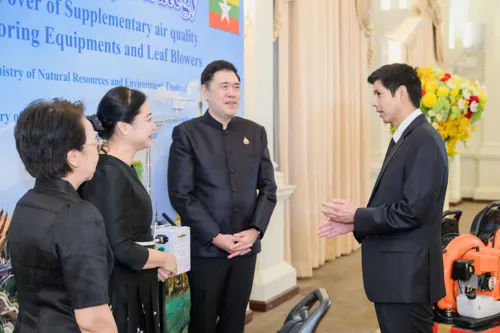
GULF Development donated air quality monitoring equipment and forest fire suppression tools to Thailand's Natural Resources and Environment Ministry for transfer to Myanmar, supporting cross-border haze and PM2.5 reduction. The initiative aligns with the government's CLEAR Sky Strategy and demonstrates private-sector commitment to environmental sustainability and regional cooperation.
▾ Hover for summary ▾ Tap for summary
US Pentagon reaffirms continued military and strategic engagement in Asia, emphasizing partnerships over dependencies.

▾ Hover for summary ▾ Tap for summary
True Corporation and the Thanyarak Foundation (under Royal Patronage) launch a Mother's Day campaign called "Check Your Breasts" (เต้า ต้อง ตรวจ) to promote breast cancer screening among Thai women. The initiative features celebrities Opal-Suchada and features self-examination education via True's EDU World platform and clinical services at Siriraj Hospital. Donors can contribute to fund medical equipment that expands screening access for underserved populations. Early detection significantly improves treatment outcomes and quality of life.
 Your real translator for LINE and Discord.

▾ Hover for summary ▾ Tap for summary
Mark Dixon, CEO of IWG (world's largest workspace provider), predicts daily office commutes will vanish by 2040 as Gen Alpha normalizes remote and flexible work. Research shows 80% of Gen Alpha expect flexible work as standard by 2040, with only 25% willing to commute over 30 minutes. As younger Gen Z/Millennial leaders—more inclined to permit remote work—ascend to executive positions, the mandatory office culture will fade, reshaping how and where work happens globally.

▾ Hover for summary ▾ Tap for summary
Thailand's government is developing "Thailand Travel Thailand Plus," a domestic tourism stimulus programme targeting small and mid-sized hotels. The scheme will offer fixed-rate hotel subsidies (proposed 2,000–3,000 baht/night) through the Krung Thai Bank's mobile app, with rollout expected in October. The initiative aims to prevent price-gouging seen in previous schemes and direct spending toward underserving SME accommodation providers rather than established chains already fully booked during peak seasons. Funding sources and backend systems still require finalisation, with details expected within the next one to two weeks.

▾ Hover for summary ▾ Tap for summary
Thailand's Deputy PM and Commerce Minister Supattanapong Panitchpakdi has established four specialized working groups to drive economic policy across creative economy, visitor economy, agriculture and food security, community economy and SMEs, and international trade. The initiative targets 4–5 urgent priorities within 6–12 months, focusing on deregulation to unlock barriers for Thai businesses and SMEs (which comprise ~35% of national revenue), modernizing agriculture, and leveraging FTA to expand export markets while rebalancing investment promotion away from import dependence.

▾ Hover for summary ▾ Tap for summary
Thailand's Department of Trade in Foreign Affairs is closely monitoring Myanmar's economic policies following its government's 100-day performance report, which emphasizes manufacturing, agriculture, energy, and infrastructure development. Thailand plans to use the Joint Trade Committee (JTC) meeting scheduled for late 2026 to negotiate and resolve trade barriers, particularly Myanmar's import licensing restrictions that have impacted Thai businesses since August 2025. The outcome depends on Myanmar's economic and political stability, which could ease negotiation of trade obstacles and support long-term business confidence between the two countries.

 Want to buy or sell a business?

▾ Hover for summary ▾ Tap for summary
Thailand's NECTEC and five private sector partners are collaborating to build a "Sovereign AI" ecosystem, addressing technology sovereignty, data control, and reducing reliance on foreign tech infrastructure. Four use cases were showcased—including AIS's ACare AI assistant and iNET's real-time health insurance claims system—demonstrating practical AI deployment with privacy safeguards and cost efficiency. The initiative reflects growing global concerns about data security, technological dependence, and the need for domestic AI capabilities.

▾ Hover for summary ▾ Tap for summary
The article discusses how artificial intelligence agents can proactively detect financial margin risks and operational vulnerabilities before they manifest as losses on balance sheets. This is relevant for Thai SMEs seeking to strengthen financial controls and risk management through technology.
▾ Hover for summary ▾ Tap for summary
A visual story analyzing the most heavily funded tech startups and companies across Southeast Asia over the past decade. This type of landscape overview can help SMEs benchmark their own funding and positioning within the regional tech ecosystem, though the specific insights depend on the full article content being accessible.

▾ Hover for summary ▾ Tap for summary
Thailand's trade with 18 FTA partners surged 21.8% in H1 2026 to $243.7 billion—57.3% of total Thai trade. Exports rose 12.6% while imports jumped 30%, though over 75% of imports are raw materials, intermediate goods, and capital equipment supporting domestic manufacturing. China remains the top FTA partner at $91.5 billion (37.6% of FTA trade). Key growth areas include agricultural exports (fresh fruit +16.8%, processed chicken +7.6%) and industrial goods (gems +26%, circuits +20.6%, computers +18.5%). The government plans to accelerate negotiations on Thailand-EU, Thailand-South Korea, and ASEAN-Canada FTAs in H2.
 Together GoWeGo! Ferry tickets in Thailand.

▾ Hover for summary ▾ Tap for summary
Thailand's Digital Economy Ministry plans to present a Cabinet resolution requiring 300 state agencies and 35,000 private systems to reset login credentials and implement multi-factor authentication (MFA) to combat widespread credential leaks—approximately 200 million Thai login records have been exposed globally. The measures include short-term credential resets, mandatory MFA implementation, and system audits to close unused/vulnerable systems, with the ministry also considering new authentication infrastructure development. While data breaches cannot be entirely prevented, these layered defenses aim to significantly raise the difficulty of system compromise.

▾ Hover for summary ▾ Tap for summary
The AI industry is shifting from Large Language Models (LLMs) to World Models—systems that understand spatial intelligence, physics, and 3D reasoning. Within 60 days in early 2026, World Labs and AMI Labs closed over $2 billion in funding to build AI systems that grasp concepts like gravity and object dynamics. Two competing approaches are emerging: "Renderers" (visual synthesis via Marble, Genie 3) and "World Understanders" (physics-accurate prediction via Cosmos, JEPA). This shift signals a move from chatbot interfaces toward AI that can operate in physical environments, drawing massive VC capital flows from VR/AR and beyond.

▾ Hover for summary ▾ Tap for summary
CP Extra (CPAXT), Thailand's major macro and Lotus operator, reported H1 2026 revenue of 268.3 billion baht (+3.6% YoY). Online sales via Makro PRO and Lotus Smart App grew 29%, driving omnichannel expansion. The company plans to scale its "Happy & Healthy Mall" strategy and pursue regional expansion across ASEAN, leveraging e-commerce growth and government stimulus to reach SME and HoReCa segments in tier-2 cities.

▾ Hover for summary ▾ Tap for summary
Over 20 countries globally have enacted or are implementing laws restricting social media access for children under 16, following Australia's December 2025 ban. Key movers include Indonesia (enforcement from March 2026), the UK (stricter rules by spring 2027), Malaysia, and France. Thailand is not yet mentioned among adopting countries, but the regional regulatory momentum—especially Indonesia's enforcement—signals SMEs must prepare for potential age-verification tech requirements and content moderation compliance. Health research links excessive screen time to developmental and mental-health harms in youth.

 Stop running your company on Excel.