
Archive
August 26, 2026
▾ Hover for summary ▾ Tap for summary
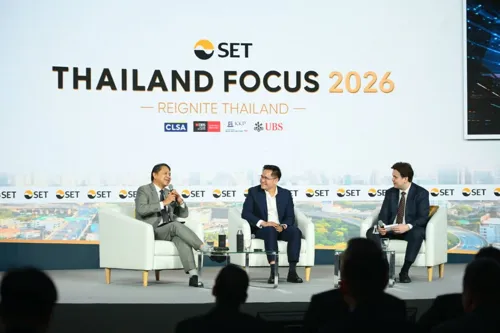
Thailand's digital infrastructure is mature enough to attract global cloud hyperscalers, but the nation ranks 37th globally in digital competitiveness due to weak AI adoption and a shortage of deep tech talent. The government strategy focuses on developing human capital, building a Thai-language LLM, and applying AI across five priority sectors (finance, manufacturing, logistics, retail, and creative content) to reduce value leakage and position Thailand as a technology innovator rather than just a consumer of foreign solutions.
▾ Hover for summary ▾ Tap for summary
Australian rare earths miner Lynas is expanding internationally and seeking new supply partnerships, which could affect global tech supply chains and electronics manufacturing.
▾ Hover for summary ▾ Tap for summary
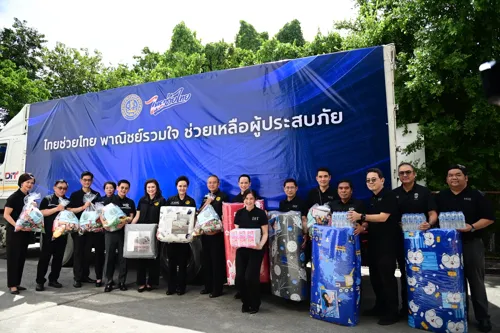
Deputy PM Suphajih coordinates disaster relief for Nan flooding, distributing 1,500 care packages and goods from public and private partners. The Ministry of Commerce is stabilizing consumer goods supply and prices in affected areas, while planning SME recovery through franchise schemes and SME D Bank financing to help businesses restart operations quickly.
▾ Hover for summary ▾ Tap for summary
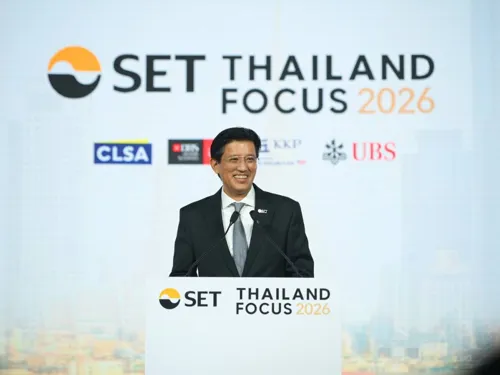
The Thai stock market achieved ~30% growth (1,200–1,600 points) in 2026, with daily trading volume exceeding $2B USD and net foreign inflows reversing to +$2B USD (~70B THB). Investor focus is shifting from regulatory concerns toward forward-looking growth strategy, particularly in Data Centers, semiconductors, and EVs. Thailand Fast Pass and BOI promotion initiatives aim to convert investment pledges into real projects. New Economy sectors and AI remain high-priority, while Thai bank stocks face Foreign Limit constraints.

 Empower businesses to thrive in the digital age.
▾ Hover for summary ▾ Tap for summary
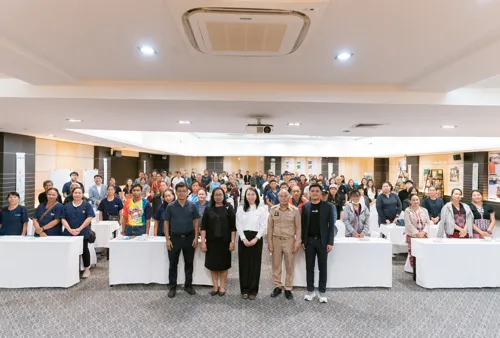
Syngenta Crop Protection and Raksa Thai Foundation launched the "Grow Well, Eat Well" program across 5 northern provinces, engaging 1,700 farming households and certifying 600+ plots with GAP standards. The initiative combines regenerative agriculture, proper crop protection, and market-linked production planning. Early results show measurable gains: lettuce farmers saw 66.7% income increase and Japanese onion farmers achieved 101.7% income growth, driven by improved yields, prices, and quality. The program emphasizes making innovation accessible to smallholder farmers through partnerships and knowledge transfer.

▾ Hover for summary ▾ Tap for summary
Indonesian wildfires with 5,122 heat sources are creating transboundary smoke affecting southern Thailand, particularly the three border provinces of Narathiwat, Pattani, and Yala. Thailand's Environment Ministry has activated air quality monitoring and early warning systems, with officials tracking wind patterns and air mass movement to assess cross-border pollution impact. Rainfall is forecast for Aug 27-29 which may help mitigate air quality issues in the upper south.
▾ Hover for summary ▾ Tap for summary
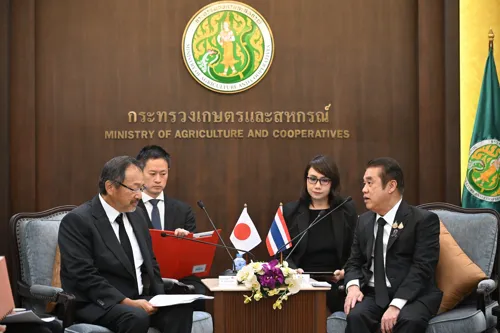
Thailand's Agriculture Minister Suriya met the Japanese Ambassador to advance smart agriculture cooperation, focusing on deploying Japanese technology and innovation to reduce labor burden on farmers—especially elderly ones—while preserving traditional knowledge. The collaboration spans the JTEPA framework (covering academic partnerships, cooperatives, SPS standards, and agri-trade), includes a 600+ sqm Thailand Pavilion at GREEN×EXPO 2027 in Yokohama, and extends to water management projects and biofuel development, with Japan offering support for two irrigation projects and recognizing Thailand's biofuel potential.
▾ Hover for summary ▾ Tap for summary
Major international banks BNP Paribas and KB Kookmin are reportedly negotiating a $2 billion investment in Vietnam's Techcombank, signaling significant regional financial consolidation in fintech-enabled banking.
 Your real translator for LINE and Discord.
▾ Hover for summary ▾ Tap for summary
Thailand's True Corporation is exploring deployment of Amazon's Kuiper LEO satellite service to expand high-speed broadband access to remote and underserved areas where fiber and 5G rollout is cost-prohibitive. True is coordinating with AWS on cloud-AI integration and studying feasibility in partnership with existing satellite license holders (TOT or Thai Kom) to address digital equity gaps across the country.

▾ Hover for summary ▾ Tap for summary
Thailand's Deputy PM and Science Minister discusses the country's potential in the space economy, emphasizing Thailand's geographic advantage for establishing a spaceport near the equator (fuel savings of 15-20%) and connections to emerging deep-tech industries. The article highlights global space economy growth (valued at $1.8 trillion USD) and warns that Thailand risks falling behind regional competitors like Singapore and China if it doesn't invest strategically—though infrastructure challenges (environmental concerns in Andaman coastal areas) and budget allocation remain key hurdles.

▾ Hover for summary ▾ Tap for summary
Thailand's National Water Resources Office (NWRO) has issued a high-alert warning for a combination of elevated tidal surge (Aug 25–29) and heavy rainfall driven by the southwest monsoon and tropical low-pressure system. The Chao Phraya River's low-lying areas across Bangkok, Nonthaburi, Pathum Thani, and Samut Prakan—especially communities outside flood barriers—face inundation risk. Water reservoir levels nationwide stand at 64% capacity, with the central region at only 37%, underscoring operational vulnerability. SMEs and manufacturers in flood-prone zones should activate contingency plans immediately.

▾ Hover for summary ▾ Tap for summary
U.S. Operation Economic Outcast sanctions on Iran could drive crude oil prices to 100–110 USD/barrel (or beyond 110 if Hormuz Strait is closed), impacting Thai SMEs through energy import costs rising ~122 billion baht annually. This threatens 5–8% cost increases for fishing and transport sectors, and could boost overall Thai inflation to 3.2–3.8% and worsen the trade deficit by ~31%. The real risk depends on China's compliance with U.S. oil purchase restrictions and Iran's retaliatory shipping actions through the critical chokepoint.

 Want to buy or sell a business?
▾ Hover for summary ▾ Tap for summary
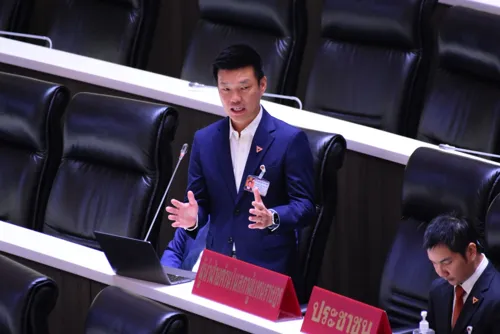
Opposition leader Nattapong Teungpanyawut has called on the government to provide clear details on its 200-billion-baht borrowing plan, particularly regarding a 12-year energy transition scheme. He argues that the government need not rely solely on borrowing and can leverage state enterprises, private sector, and existing funds for energy infrastructure investments. The opposition demands transparency on constitutional justification and concrete spending plans before approving the decree.

▾ Hover for summary ▾ Tap for summary
Thailand's National Economic and Social Development Council (NESDB) released Q2 2025 employment data showing positive job creation (+5.1%) but also real wage decline (-2.88% after inflation adjustment). Key labour challenges identified include: mandatory employee welfare fund enforcement from October 1st (affecting 107,000+ businesses and 5.7M workers), El Niño agricultural impacts, illegal migrant labour (+19.3% in illegal reserved occupations), and critical protection gaps in the growing gig economy (projected 460K workers in 2025, with inadequate healthcare, income security, and algorithmic accountability protections). Government is developing new legislation to address platform worker rights, following international ILO standards.

▾ Hover for summary ▾ Tap for summary
iApp Technology, a Thai AI company, launched OpenThai 2.0 Legal—an open-weight large language model designed specifically for Thai law. Built on NVIDIA Nemotron and available for free download, the model can recall and cite Thai laws and court decisions without explicit legal text in prompts. It outperforms larger competitors like Qwen 35B in Thai civil and commercial law benchmarks and can run on a single GPU with 24GB+ VRAM, enabling organizations to self-host sensitive case data. This release reflects Thailand's broader AI industry boom, with Q1 2026 investment applications up 2.4x to 1.02 trillion baht.

▾ Hover for summary ▾ Tap for summary
Garmin has launched the fēnix 9 and fēnix 9 Pro premium smartwatches (starting at 33,490 and 36,990 baht respectively), targeting athletes and outdoor enthusiasts. Key upgrades include a new "Epic" feature for multi-activity storytelling, enhanced Stamina tracking, 50% more RAM, brighter AMOLED displays (up to 3,000 nits on Pro), built-in maps with faster navigation, and satellite connectivity on the Pro model. Available September 15 in three sizes (43–51 mm), offering up to 29–57 days battery life depending on model and features.
 Together GoWeGo! Ferry tickets in Thailand.

▾ Hover for summary ▾ Tap for summary
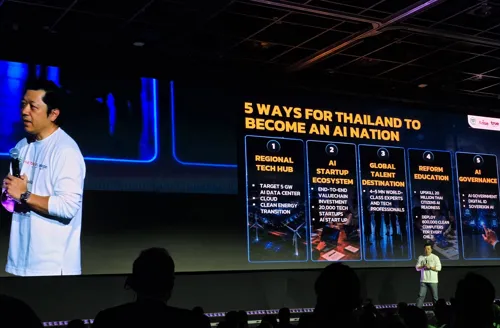
At Techsauce Global Summit 2026, Oranuch Lertsuwannakij outlined four critical insights for Thai tech leaders: (1) Global power realignment creates supply chain opportunities for Southeast Asia and Thailand to position itself as a strategic hub rather than low-cost manufacturer; (2) AI adoption is still at single-digit operational usage despite 88% of organizations claiming adoption, making implementation and organizational redesign the true competitive differentiator; (3) AI won't replace human value but shifts it to higher-level skills—strategy, critical thinking, judgment, and accountability remain irreplaceable; (4) Success requires anticipating market direction, choosing favorable terrain, converting ideas to action, and partnering strategically.
▾ Hover for summary ▾ Tap for summary
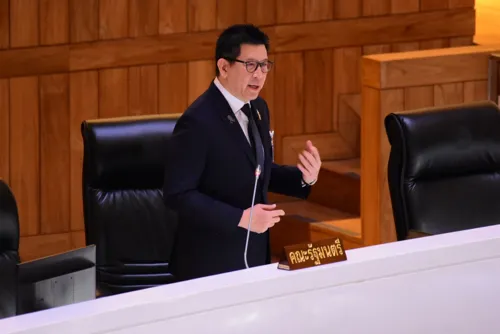
Thailand's Deputy PM and Finance Minister Ekniti justified a 400 billion baht emergency loan decree to address energy-driven economic crisis and fund transition to clean energy. The decree targets three pillars: immediate economic relief, accelerated shift to renewable energy with private sector participation, and foreign clean energy investment. The minister emphasized transparent fund allocation via strict project screening, no cash hoarding, and continuous monitoring. Long-term goal is to reduce fossil fuel import dependency (currently high from Middle East) and strengthen the economy post-crisis through improved energy infrastructure.

▾ Hover for summary ▾ Tap for summary
The Thai government's "Thailand Travel Thailand Plus" co-payment stimulus programme aims to boost tourism in Q4 by offering up to 3,000 baht discounts across 500,000 vouchers nationwide. However, private sector leaders (SME Federation Chiang Mai) highlight a critical bottleneck: only ~50% of accommodation properties have proper hotel licences, locking out smaller homestays, guesthouses, and community-based operators from accessing state funds. The federation is proposing an "SME Plus" model to relax licensing criteria in favour of basic safety/hygiene standards and expand voucher systems to include restaurants and local activities, aiming to ensure benefits actually reach grassroots entrepreneurs rather than concentrating in large 3–5-star chains.
▾ Hover for summary ▾ Tap for summary
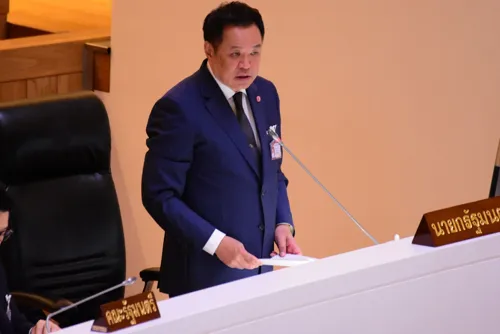
Thailand's PM presented a 400-billion-baht emergency decree to Parliament to address an energy crisis and fund transition to renewable energy. The borrowing targets reducing living costs and business expenses while accelerating renewable adoption. Government asserts public debt will remain below 70% of GDP. This directly impacts SME operating costs and energy procurement strategy going forward.

 Stop running your company on Excel.