
Archive
September 19, 2026

▾ Hover for summary ▾ Tap for summary
Nvidia is investing $2 billion into Brookfield's AI infrastructure fund, signaling major capital commitments toward building global AI compute capacity. This reflects the accelerating demand for data center infrastructure and GPU resources to support AI workloads. For Thailand SMEs, this highlights the growing importance of AI infrastructure investment and potential opportunities in supporting ecosystem services as AI adoption scales globally.

▾ Hover for summary ▾ Tap for summary
Thailand's National EV Policy Committee has approved a three-tier excise tax structure to incentivize domestic EV manufacturing and penalize imports. Imported CBUs face 30% tax, while domestically-produced EVs with local content (30–40%) pay just 1–6%. Chinese EV importers (Geely, FAW/HONGQI, XPeng, Tesla, etc.) are accelerating plans to establish Thai production facilities and secure BOI promotion certificates before 2571 (2028) to qualify for lower tax brackets, fundamentally reshaping market entry strategy.

▾ Hover for summary ▾ Tap for summary
EEC real estate (Chachoengsao, Rayong, Chonburi) is stabilizing with declining inventory (down 3.8% YoY) and improving absorption rates as industrial demand picks up. Chonburi condos show strong recovery (74.5% sales growth, 3.0% monthly absorption), particularly near industrial parks and tourist zones. However, Rayong faces structural headwinds—flat worker-driven demand, oversupply of mid-range housing (3–5M baht), and 54-month absorption timeline for remaining units pose medium-term risks. City expansion from Bangkok (especially Chachoengsao) offers modest upside. Market is shifting from investment-led to real-demand driven, constrained by household debt and tighter credit.

▾ Hover for summary ▾ Tap for summary
Thailand's Craft Beer Association is calling for urgent clarification of alcohol advertising regulations following the Lisa BLACKPINK social media controversy. The core issue: the updated Alcohol Beverage Advertising Act lacks implementing rules (sub-decrees), leaving officials with broad discretionary power to interpret ambiguous provisions. Article 32/2 specifically creates vague liability for using one's reputation to promote alcohol with "intent to induce consumption"—language agencies could weaponize against ordinary citizens sharing content. The association warns this opens the door to arbitrary enforcement and demands clear, context-aware guidelines that protect legitimate business and speech rather than serve as a penalty tool.

 Empower businesses to thrive in the digital age.

▾ Hover for summary ▾ Tap for summary
The U.S. Federal Reserve has raised interest rates to 3.75–4%, signaling continued monetary tightening through year-end as inflation remains elevated at 3.7% PCE and is not expected to return to the 2% target until 2029. Key implications for Thai SMEs and investors: higher U.S. Treasury yields (10-year at 5%), stronger dollar, and near-term pressure on growth/tech stocks globally. However, historical patterns show equities often rebound 6–12 months after the first rate hike, making selective buying opportunities available for quality companies as the economy still shows strong fundamentals.

▾ Hover for summary ▾ Tap for summary
Thailand's central bank maintains its policy interest rate at 1% and is expected to hold this level through 2027, diverging from the US Fed's recent hikes to 3.75–4%. Large Thai corporations are shifting from bond issuance to bank loans to secure cheaper financing as bond yields rise. While current impact on the Thai economy remains limited, risks loom from widening US-Thailand rate differentials, potential capital outflows, currency pressures on the baht, and rising business costs—particularly if oil prices remain elevated and current account deficits deepen.

▾ Hover for summary ▾ Tap for summary
Article explores the realistic post-hype landscape for AI adoption and practical applications. Unable to access full content due to JavaScript requirements, but the title suggests focus on moving beyond inflated expectations toward genuine business value and use cases.
▾ Hover for summary ▾ Tap for summary
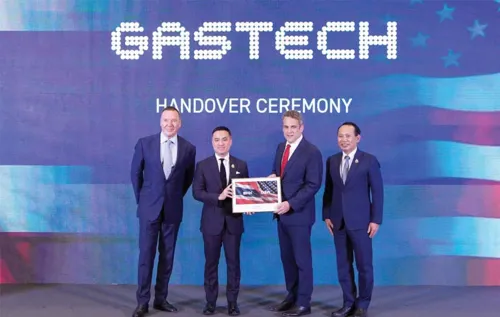
Thailand wrapped up GASTECH2026 with nearly 60,000 attendees from 150 countries, generating ~1.32 quadrillion baht (USD 40 billion) in energy deals covering LNG, natural gas, power generation, and petrochemicals. Key agreements include B.Grimm Power-GE Vernova deals for gas turbines, Petronas-PTT E&P production-sharing contracts, and China Gas-Venture Global LNG purchases. The government is simultaneously finalizing the Power Development Plan (PDP2026) to guide national energy development, with power ministry reviewing four strategic scenarios to address electricity demand gaps amid rapid data center growth and aging power plant transitions.
 Your real translator for LINE and Discord.
September 18, 2026

▾ Hover for summary ▾ Tap for summary
Thailand's government postponed the 4-billion-baht "Thailand Travel Plus" stimulus program from October 2026 to April 2027, disappointing hospitality and tourism SMEs across secondary cities who had already prepared registration and campaigns. The delay sparks concern about program credibility and execution; hotel associations requested the government move stimulus to low season (April-June) instead, while meanwhile the Tourism Authority plans a consolation "Bus Tour Thailand" campaign (October-December) offering 10,000 baht/day per bus to group tour operators.

▾ Hover for summary ▾ Tap for summary
Thailand's government has postponed the "Visit Thailand Plus" 4-billion-baht subsidy programme from October 2026 to April–June 2027, disappointing hospitality operators who had prepared for a high-season campaign launch. The Thai Hotel Association (THA) warns of lost support for secondary cities and low-season tourism, though industry leaders acknowledge the April shift to low-season timing may ultimately help SME properties. The Tourism Authority of Thailand (TAT) is introducing a competing "Bus Tour Thailand" initiative (October–December 2026, 8M baht budget) to soften the blow and boost group travel.

▾ Hover for summary ▾ Tap for summary
Thailand's government is considering extending the Thais Help Thais Plus co-payment scheme with an additional 1,000-baht one-off allowance to be spent over two months. State welfare cardholders would receive 700 baht on top of their regular 300-baht entitlement. The proposal aims to ease cost-of-living pressures and stimulate consumption; final conditions will be announced after cabinet approval expected Tuesday. This affects lower-income consumers directly but represents incremental welfare adjustment rather than structural policy change.

▾ Hover for summary ▾ Tap for summary
iPhone 18 Pro and Pro Max launched in Thailand with stronger-than-expected first-day sales, driven by replacement demand and competitive trade-in/financing offers from retailers like 7-Eleven, AIS, and True. Trade-in values ranged 8,000–10,000 THB depending on model, with 0% interest installments and 48-month FMFU loans boosting affordability. Thai SMEs in retail, mobile, and device services benefit from accessory and bundled service ecosystems, while rising memory costs suggest pricing pressure through mid-2027.

 Want to buy or sell a business?
▾ Hover for summary ▾ Tap for summary
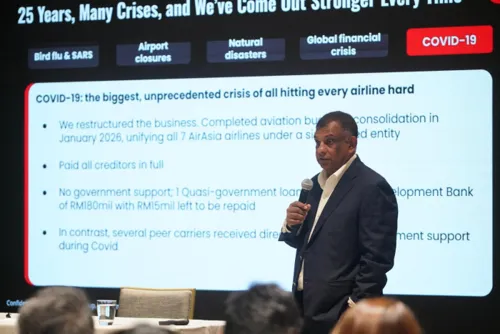
AirAsia denies Malaysian government bailout rumours, confirming refinancing plans to secure US$1B in pandemic relief loans by November/December. Thai AirAsia aims to maintain its 26% market share and largest domestic position by optimizing operations—cutting ~60 loss-making routes, reducing fuel costs via efficient aircraft, and shifting long-haul expansion to code-share partnerships. The airline expects Q4 profit if fuel demand remains strong but faces near-term cash flow challenges; it filed for a two-year debt repayment suspension with Central Bankruptcy Court.

▾ Hover for summary ▾ Tap for summary
Thailand's liberal gold import regime—historically a cornerstone of the domestic trade—faces potential regulatory tightening as authorities seek to prevent money laundering through gold transactions. The Bank of Thailand and Finance Ministry are drafting joint legislation to create a dedicated regulatory framework for gold trading, including possible transaction taxes (as low as 0.1%) and mandatory reporting requirements. While officials stress the goal is enforcement and tracking rather than revenue generation, concerns remain that overly strict measures could disrupt Thailand's established gold market and push activity underground.
▾ Hover for summary ▾ Tap for summary
Thailand's Trade Competition Commission (TCCT) is strengthening digital platform regulations following a landmark 343.8 million baht fine against Shopee for unfair competition practices. The watchdog plans to examine fee structures, evaluate gross profit margins, and has authority to freeze fee increases for six months. This signals tighter oversight of e-commerce platforms' pricing and vendor treatment, directly impacting SMEs selling on major platforms.
▾ Hover for summary ▾ Tap for summary
Thailand's Trade Competition Commission (TCCT) is strengthening regulations on digital commerce platforms following enforcement actions against Shopee for enrolling vendors without consent into promotional campaigns and collecting unauthorized fees. The TCCT is examining whether platform fee increases are fair based on gross profit margins and has ordered platforms to suspend fee increases for six months while providing supporting documentation. This signals tighter regulatory oversight of e-commerce operations in Thailand.
 Together GoWeGo! Ferry tickets in Thailand.

▾ Hover for summary ▾ Tap for summary
Huawei announced the Atlas 960E SuperPoD supercomputer and Peerium computing architecture at HUAWEI CONNECT 2026, addressing the massive computing demands of the Agentic AI era. The Atlas 960E uses Near-Packaged Optics (NPO) technology to achieve 2.75× better efficiency over traditional servers, supporting up to 4,096 AI cards with 8 EFLOPS compute power and 1 Petabyte HBM. Peerium's peer-to-peer chip interconnect enables coordination of 1 million processors seamlessly, shifting away from traditional master-slave architectures. These innovations target enterprises scaling large AI inference and training workloads, with potential applications across data centers, cloud providers, and AI-intensive industries.

▾ Hover for summary ▾ Tap for summary
Thailand's BOI, SET, and SEC have signed an MOU launching "BOI to IPO" — a framework to help BOI-promoted companies, especially in New Economy sectors, access capital markets for growth. The initiative aims to position Thailand as a long-term business hub, not just a manufacturing base. A major wave of 5 trillion baht in investment approvals since 2023 — spanning semiconductors, PCBs, AI supply chains, EVs, robotics, and biotech — is reaching the funding stage. New Economy IPO entrants will receive enhanced tax incentives: 3 extra years of full corporate income tax exemption or 5 additional years of 50% relief, plus upstream R&D integration via Skill Bridge training.

▾ Hover for summary ▾ Tap for summary
A forensic psychologist explains why intelligence and education don't protect against fraud—scammers exploit emotion over reason through social engineering. AI-enabled deepfakes intensify the threat by creating convincing fake identities. The core vulnerability isn't IQ but EQ: when triggered by greed, fear, or delusion, the brain's emotional amygdala overrides logical reasoning. Thai SMEs and professionals should recognize that fraud success depends on manipulating emotions during high-pressure decisions, not outsmarting technology defenses.

▾ Hover for summary ▾ Tap for summary
Thailand's Ministry of Higher Education and Ministry of Public Health are launching a 3-year collaboration to operationalize Medical AI in hospitals. Key initiative: connecting university research with health system needs via HPC and GPU infrastructure, establishing validation/certification frameworks, and piloting 3 Medical AI tools (hip fracture detection, liver cancer screening via ultrasound, and others). This bridges research-to-deployment gap and positions Thailand as a regional leader in clinical AI adoption with proper data governance.

 Stop running your company on Excel.