
Archive
September 3, 2026
▾ Hover for summary ▾ Tap for summary
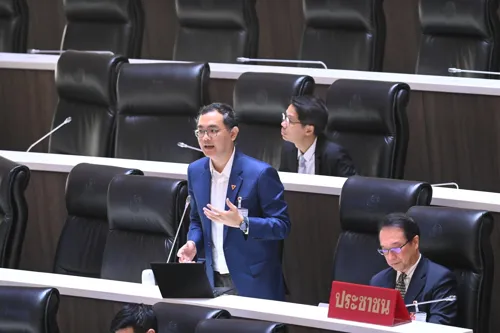
A former tech executive and MP critically examines Thailand's data center debate, arguing they are necessary infrastructure (like modern power plants) but not an economic silver bullet. He warns against inflated expectations of job creation and wealth, notes data centers require robust environmental regulation (which Thailand lacks), and urges Thailand to stop seeking handouts—international operators should compete to offer Thailand genuine benefits instead.

▾ Hover for summary ▾ Tap for summary
The article discusses common misconceptions and strategic mistakes that Southeast Asian startup founders make when attempting to enter and expand in the US market—a critical topic for regional entrepreneurs seeking international growth and capital.

▾ Hover for summary ▾ Tap for summary
Four SPACE-F Batch 7 startups are building AI-powered foodtech solutions addressing personalized nutrition and supply chain complexity. Eatwellconcept (Thailand) connects AI-powered nutrition design with meal delivery for NCD patients; Jola (Thailand) offers customizable pet nutrition; Openfarming (Saudi Arabia) automates multi-channel order aggregation for food distributors; YiXingYuan (Taiwan) develops modular processing units using high-voltage electric fields near production sites. Together they tackle the full chain—from personalized meal planning and pet wellness to backend logistics and post-harvest preservation—representing meaningful venture activity in regional foodtech.

▾ Hover for summary ▾ Tap for summary
Thailand's Capital Market Development Fund (CMDF) is launching a 1 billion baht Private Equity Trust with 300 million from CMDF and 700 million from partner institutions to support mid-sized and small businesses plus startups in tech, medical, and agri-tech sectors—addressing SME access to capital. The fund has a 10-year lifespan split into 4-5 years investment and 4-5 years exit phases. CMDF is also expanding its Jump+ program (now 142 participating companies, mostly market-cap under 5 billion baht with low analyst coverage) and launching a 5-year IPO subsidy scheme with up to 7 million baht per company. Additionally, cyber-security infrastructure and data-sharing platforms are being deployed to bolster market trust—addressing past systemic risks.

 Empower businesses to thrive in the digital age.

▾ Hover for summary ▾ Tap for summary
Nestlé has secured BOI approval to invest 6.4 billion baht in two pet food and treat manufacturing facilities in Rayong, targeting >90% export to key markets like the US, Canada, Japan, and Australia. Thailand ranks #2 globally in pet food exports; this investment leverages domestic raw materials (56-88% sourcing, ~450 million baht/year in local inputs) and positions Thailand as a strategic production hub while strengthening linkages to local agricultural suppliers.

▾ Hover for summary ▾ Tap for summary
Burley Yogurt (BJC), a Thailand-based company operating for 144+ years, successfully closed a 15 billion baht debenture offering with investor demand exceeding the target by 2.42x, raising total issuance to 19.1 billion baht. The four-tranche unsubordinated debenture received an 'A' rating from TrisRatings with a Stable outlook, demonstrating investor confidence in the company's market position and revenue diversification.
▾ Hover for summary ▾ Tap for summary
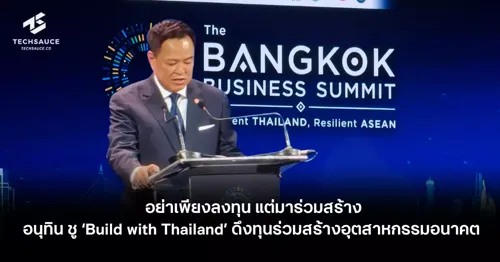
PM Anutin announced a strategic shift at Bangkok Business Summit 2026, calling on foreign investors to move beyond passive investment toward co-creating Thailand's future industries. The "Build with Thailand" initiative emphasizes leveraging existing industrial clusters, skilled labour, supply chains, and digital infrastructure across automotive, electronics, food, health, and tourism sectors while supporting SME development. Key competitive advantages include Thailand's ASEAN hub position (serving ~1.7 billion people), ability to integrate emerging tech with established industries, and commitment to climate investment, green energy, and an aging-economy business model—backed by regulatory streamlining and potential OECD membership to boost investor confidence.

▾ Hover for summary ▾ Tap for summary
CGSI Securities forecasts a technical rebound in the Thai stock market (SET Index) within the 1,570–1,585 range today, supported by moderating US bond yields and declining pressure on risk assets. The firm recommends Delta Electronics (DELTA) and Prarammitr Hospital (PR9) as buys for H2 2026, citing expected revenue and margin recovery, with specific profit-taking and stop-loss targets provided. Key watch: US non-farm payroll data will guide Fed policy signals affecting global capital flows.
 Your real translator for LINE and Discord.
▾ Hover for summary ▾ Tap for summary
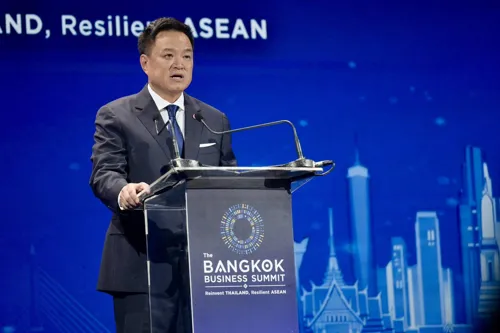
PM Anupong Paochinda unveiled "Thailand's Offer" strategy at Bangkok Business Summit 2026, positioning Thailand as a platform for advanced tech, AI, green transition, and longevity economy investments. Key initiatives include regulatory reform (7,000+ laws under review), OECD membership alignment, and industry cluster development across automotive, electronics, food, and healthcare. The focus emphasizes quality investments that build local suppliers, train Thai workforce, and develop domestic knowledge—positioning Thailand as a partner in co-creating future industries, not just a manufacturing base.
▾ Hover for summary ▾ Tap for summary
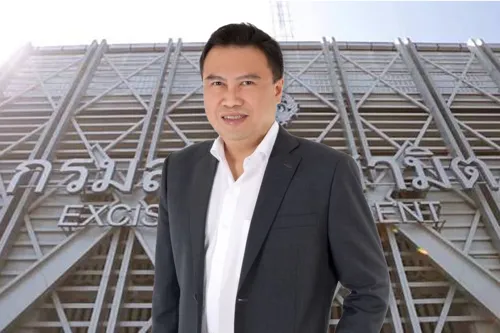
Thailand's Excise Department is pursuing multiple tax policy changes to boost FY2569 revenue collection, which is tracking 1% below target. Key initiatives include: converting the dual-tier cigarette tax system to a single-rate structure to reduce revenue loss of 10-20 billion baht annually caused by consumer migration to lower-taxed products; eliminating tax exemptions on tobacco exports to combat smuggling, using a collect-first, refund-later system; and revising EV vehicle taxation pending EV Board and cabinet approval. The Department also reports enforcement efforts intercepted 35,739 excise violations in 11 months, with tobacco products remaining the top enforcement focus.

▾ Hover for summary ▾ Tap for summary
Brent and WTI crude oil prices rose over 1% following escalated military conflict between the US and Iran, with fresh strikes on Iranian coastal facilities and Iranian retaliation against US bases. Supply concerns are elevated: US crude inventories fell 4.5M barrels (more than expected), though transit through Hormuz Strait remained steady at ~17M barrels on the latest day. Thai SMEs and enterprises dependent on energy costs face immediate margin pressure as geopolitical risk premiums persist.

▾ Hover for summary ▾ Tap for summary
Thailand's Individual Savings Account (TISA) program has been delayed and will not launch by end of 2026 as originally hoped, now targeting January 2027 onwards. The Finance Ministry commits to releasing clear guidelines within 2026 to allow securities firms time to build supporting systems for individual stock investment tracking and tax-advantaged accounts. FETCO emphasizes TISA's role as a domestic savings tool to support the government's target of raising investment to 30% of GDP, with current savings at ~25% of GDP. Market analysts view the timeline clarification positively for long-term capital inflow, though final impact depends on tax incentive limits and eligible asset types—each 100 billion baht inflow could boost the Thai stock index by 25–30 points.

 Want to buy or sell a business?

▾ Hover for summary ▾ Tap for summary
World Labs, the AI company founded by Fei-Fei Li, has launched Atlas, a multimodal world model that generates realistic 3D virtual environments from reference images, text, video, or 3D models. The key advancement is precise camera control and spatial context understanding, allowing high-fidelity 3D world generation from a single image. This represents meaningful progress in generative AI with potential applications in game development, virtual reality, and digital content creation.
▾ Hover for summary ▾ Tap for summary
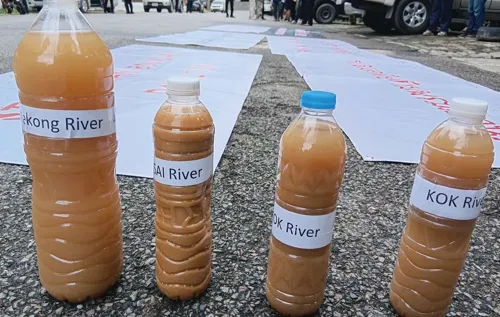
River contamination from mining operations on the Myanmar border is polluting Thailand's water supplies and food chain with heavy metals. The Chiang Rai water utility must shift water sources at a cost of over 2 billion baht, affecting ~120,000 people. The crisis spans three critical areas: drinking water infrastructure, agricultural contamination (particularly rice paddies covering ~100,000 rai), and long-term bioaccumulation in human bodies. Expert Dr. Suebsakul proposes halting all ore imports from Myanmar to increase negotiating leverage and advocates legal recognition of "river rights" to systematically protect ecosystems.

▾ Hover for summary ▾ Tap for summary
Thailand's government is advancing a "Nature Positive" framework beyond Net Zero, using backasting methodology to restore lost biodiversity while creating economic opportunities for communities. Deputy PM Prof. Yotchanan Wongsuwan proposes integrating science, public-private partnerships, and circular economy mechanisms—particularly targeting agricultural waste into revenue streams—to ensure nature restoration doesn't sacrifice rural livelihoods. This multi-sector initiative aims to rebuild ecosystem health in high-risk areas through government-backed R&D, then scale solutions via private and community sectors.
▾ Hover for summary ▾ Tap for summary
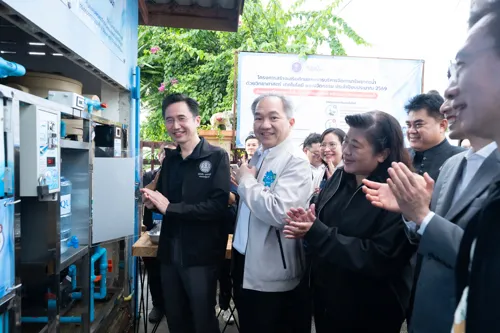
Thailand's NSTDA and synchrotron research institute have delivered a village water treatment system prototype to remove arsenic from the Kok River basin, addressing a critical environmental and public health challenge. The A-QUALITY initiative demonstrates practical application of nanotechnology and synchrotron analysis to solve water contamination, covering 700+ households. This represents a model for translating research into community-level technology deployment, with broader potential for scaling water purification solutions across Thailand.
 Together GoWeGo! Ferry tickets in Thailand.

▾ Hover for summary ▾ Tap for summary
Deputy PM Ekanat Nitithanprapas indicated that investment inflows and tourism events—including the IMF-World Bank annual meeting and GASTECH conference in Q4—are expected to support the economy after the "Thai Help Thai Plus" stimulus programme expires in September. The government plans to avoid short-term stimulus dependence, focusing instead on large infrastructure projects (including 400-billion-baht solar rooftop initiatives) and international investor engagement to sustain growth momentum.

▾ Hover for summary ▾ Tap for summary
Equinix has announced new AI infrastructure services developed in partnership with Nvidia and AWS. This signals the consolidation of AI capabilities among major data center and cloud providers, relevant to Thai enterprises seeking scalable AI deployment options. However, the partnership is globally oriented and may have limited direct impact on local SMEs without cloud infrastructure strategies.

▾ Hover for summary ▾ Tap for summary
Thailand faces overlapping structural and macroeconomic crises—aging society, debt overload, wage-inequality mismatch, and geopolitical volatility—requiring businesses and institutions to collaborate on adaptation. Featured case: TTB bank redesigned risk assessment to offer lower interest rates (13.99% vs. 24%) to good-credit customers regardless of income, and launched a "Coach Out of Debt" program that helped ~30% of participants return to positive cash flow through systematic debt restructuring. The article emphasizes that crisis response cannot be handled by any single organization alone.

▾ Hover for summary ▾ Tap for summary
Brave browser launches Email Aliases feature, allowing users to create masked email identities for online registrations without exposing their real email address. Users get 5 free aliases per account with email forwarding to their registered inbox; Premium subscribers will receive additional features. This privacy-focused tool addresses growing user concerns about data collection and email spam.

 Stop running your company on Excel.