
Archive
September 4, 2026

▾ Hover for summary ▾ Tap for summary
Thailand's EV Board meeting is rescheduled from September 7 to September 10, with the Prime Minister presiding. The agenda focuses on reviewing overall EV promotion policy direction and segmenting EV vehicles/businesses into distinct groups for tailored support strategies. Importantly, tax rate increases (proposed at 35-50% by industry bodies) and import quotas will not be discussed—these remain separate Ministry of Finance decisions outside the board's purview.
▾ Hover for summary ▾ Tap for summary
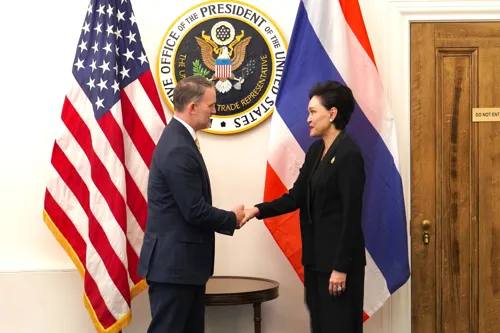
Thailand's Deputy PM and Commerce Minister Supachai held talks with US Trade Representative officials in Washington, achieving substantial progress on the Agreement on Reciprocal Trade (ART). Both sides are rushing to finalize technical details before the US announces Section 301 investigation results on structural overcapacity. The US assured Thailand of fair, competitive tariffs. This deal is critical: US is Thailand's #1 export market (worth 2.37 trillion baht) supporting 400,000+ jobs. Thailand has already seen reciprocal tariffs drop from 36% to 19% under IEEPA, then to 10-12.5% under Section 122/301. Closing ART would lock in competitive rates and strengthen investor confidence.
▾ Hover for summary ▾ Tap for summary
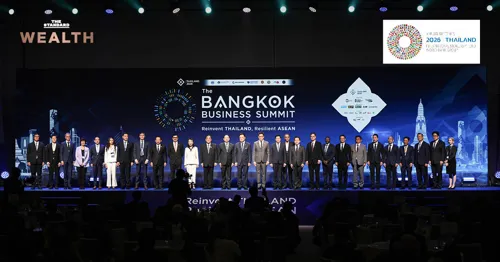
Thailand's government and private sector leaders convened at the Bangkok Business Summit 2026 to coordinate policy and business strategy under the theme "Reinvent Thailand, Resilient ASEAN." Key outcomes include: (1) alignment on shared goals to position Thailand as a growth driver for ASEAN; (2) commitment to integrated public-private implementation across problem definition, solution design, execution, and monitoring; (3) three-level execution framework spanning global (IMF-World Bank meetings Oct 12–18), regional (G2G, B2B, Gov-B partnerships), and national (four pillars: investment, trade & community economy, human capital, state efficiency). World Bank and IFC confirmed strategic partnership. For Thai SMEs, this signals policy clarity, infrastructure expansion (energy, digital, finance), and regional business network opportunities.
▾ Hover for summary ▾ Tap for summary
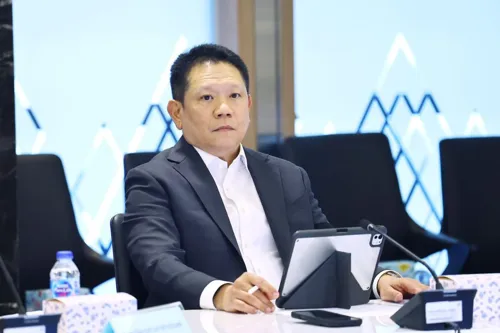
Thailand's Deputy Finance Minister confirms an EV Board meeting on September 10 to review the direction and effectiveness of electric vehicle promotion policy. The discussion will focus on policy principles—including segmentation of EV vehicles and operators, and tailored support mechanisms for different groups (imported vehicles vs. domestic production-based, various investment models)—rather than implementation details like tax rates or import quotas. This signals a potential policy reset for Thailand's EV strategy.

 Empower businesses to thrive in the digital age.

▾ Hover for summary ▾ Tap for summary
JMART and SGC (part of the Jaymart ecosystem) welcome the Bank of Thailand's new regulatory framework for non-bank lending and BNPL services as positive for the fintech industry. SGC has already accumulated over 20 billion baht in new loan disbursements in lockphone credit over two years and claims readiness for stricter compliance standards. The regulatory move aims to establish competitive standards, enhance consumer protection, and encourage responsible lending practices—aligning with how major players are already operating.
▾ Hover for summary ▾ Tap for summary
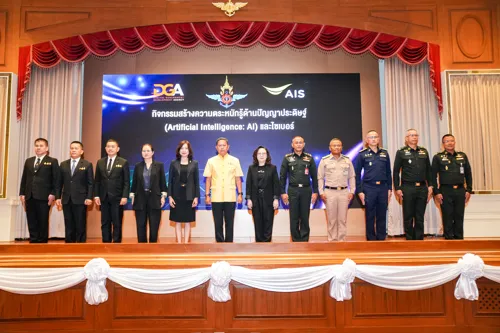
AIS, Thailand's Defense Ministry, and DGA launched a joint initiative to build AI and cybersecurity literacy among military personnel, government staff, and families. The program aims to develop 'digital workforce' capabilities through skills training on responsible AI use and cyber defense, integrating curriculum via DGA's TDGA platform. While strategically important for national security, the announcement emphasizes intent and partnerships rather than concrete implementation timelines or measurable outcomes.
▾ Hover for summary ▾ Tap for summary
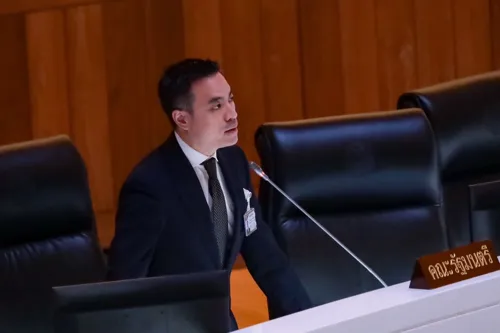
Thailand's Energy Ministry has escalated enforcement under its "Sudsoi Energy" anti-hoarding campaign by filing evidence with the Office of the Trade Competition Commission (OTCC) against 5 additional oil storage depots suspected of supply manipulation during the March fuel shortage. Investigators found abnormal inventory patterns—including received fuel not being released and average remaining stock 1.67 million liters above normal—affecting multiple depots. 21 traders have been referred for legal proceedings under trade competition and consumer protection laws. The ministry plans system upgrades including real-time monitoring alerts and supply chain oversight to prevent future price-gouging incidents.
▾ Hover for summary ▾ Tap for summary
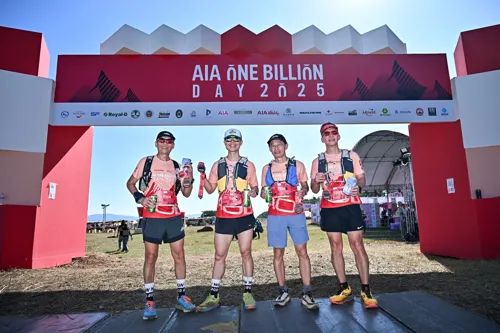
AIA Thailand, Thailand's Tourism Authority, and Prao Group announce the 5th edition of "AIA One Billion Day 2026," a major health and lifestyle festival scheduled for November 21, 2026, in Hua Hin. The event combines an international-standard trail running race (UTMB Index certified, with distances from 5–50km), concert performances, wellness activities, and carnival entertainment. Previous year (2025) drew 4,600+ participants and raised funds for charity. The initiative supports AIA's "One Billion" mission to inspire healthier lives across Asia-Pacific by 2030 and promotes Hua Hin as a health-focused destination.
 Your real translator for LINE and Discord.

▾ Hover for summary ▾ Tap for summary
Thailand's BDE launched TH-AI Passport to boost digital and AI skills across the population. Within 3 days, the platform hit 1.47M registrations and 4M prompt commands (averaging 2.7 per user), with 722K users completing lessons and 113.7K earning certificates. The government is paying providers ~24.70 THB per active monthly user. This signals major push for AI democratization, but engagement metrics remain low early on—the 2.7 prompts/user average and modest certification rates suggest early-stage adoption and potential uptake challenges ahead.

▾ Hover for summary ▾ Tap for summary
An Air India A320 flying from Phuket to Delhi lost all three hydraulic systems for four seconds in August, causing pitch oscillations that injured 24 passengers when seatbelt signs were off. The captain subsequently tested non-negative for a psychoactive substance (reportedly marijuana), prompting India to consider mandatory annual drug testing for all pilots and adding pressure on Air India following a fatal 787 crash in June that killed 260 people.

▾ Hover for summary ▾ Tap for summary
An Air India A320 cruising at 36,000 feet experienced a rare cascading hydraulic system failure (all three systems lost within 4 seconds) on an August 4 flight from Phuket to New Delhi, triggering a stall warning and violent pitch movements that injured 24 passengers. The incident was triggered while seatbelt signs were off. Investigators found the captain tested non-negative for psychoactive substances, adding to scrutiny following Air India's fatal 2025 Boeing 787 crash. India is now considering mandatory annual drug testing for all pilots, and Airbus has flagged the systemic hydraulic loss as a serious concern requiring priority regulatory action.
▾ Hover for summary ▾ Tap for summary
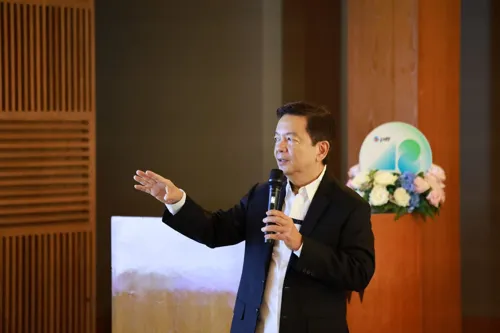
PTT CEO Kongkrapan outlined the company's strategy to navigate Middle East tensions and global energy volatility: diversifying crude oil sources, expanding LNG portfolio to 10 million tonnes by 2573, investing in multi-feedstock refineries, and advancing carbon capture projects. H1 2569 net profit surged 74% to 78.3 billion baht. The company balances its dual role as state enterprise and listed company while pursuing sustainable energy security for Thailand.

 Want to buy or sell a business?

▾ Hover for summary ▾ Tap for summary
Billions of baht in loans for AI data centers are being labeled "green" to reduce borrowing costs, but lack clear certification standards. Only in April 2026 did nine global organizations form the Greening AI Data Centers Coalition to define what "green" means in this context. The article warns that investors—including pension funds and ESG-managed portfolios—are sacrificing yield based on unverified claims. Key questions investors should ask: Does documentation show fund destination? Are post-deployment reports provided? Who independently certifies compliance? Without rigorous third-party verification (standards, oversight, penalties), the green label remains marketing, not substance.
▾ Hover for summary ▾ Tap for summary
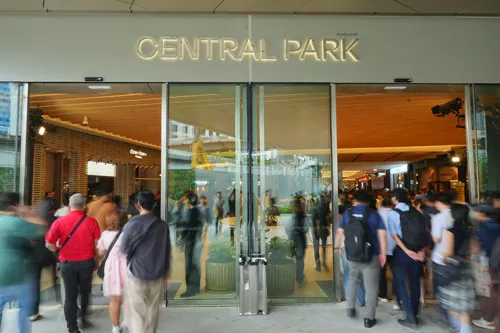
Central Park, a major Bangkok shopping and lifestyle destination, is repositioning itself as "Bangkok's World Stage" to attract global tourists and Thai visitors. The mall targets 10% traffic growth to 27 million visits annually by 2027, driven by three strategies: bringing global brand launches, hosting world-class cultural events, and expanding international audience reach. Additional traffic boost expected from completion of office (80% leased) and residential (97% sold) components, plus a new BTS connector tunnel by Q1 2027. Anniversary celebrations feature exclusive collaborations with tenants and promotional cashback offers.

▾ Hover for summary ▾ Tap for summary
Thailand's government is launching the second tranche of "Savings Plus" bonds Sept 7–9, 2026, offering 1.8% (3-year) or 2.8% (10-year) fixed returns via Bond Connect system. Minimum investment is 1,000 baht with no maximum cap; sales distributed fairly via "Small Lot First" allocation. Available through 24 distributors (6 banks, 18 brokerages) and the Streaming app. Direct retail savings opportunity with transparent, low barrier to entry.
▾ Hover for summary ▾ Tap for summary
Krungsri Bank and MUFG held the 2026 Business Matching Fair, successfully pairing 3,000 Thai-Japanese business partnerships since 2013. The event brought 42 Japanese and 18 Thai companies across food & beverage, beauty, healthcare, fashion, tourism, and retail sectors. Participating Japanese firms gain direct access to Thai consumers via NIPPON HAKU BANGKOK 2026 and market insights to support future expansion—a testament to sustained bilateral trade momentum.
 Together GoWeGo! Ferry tickets in Thailand.
▾ Hover for summary ▾ Tap for summary
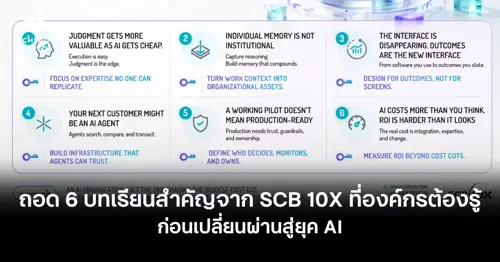
SCB 10X, the investment arm of SCBX Group, synthesizes six critical lessons from AI-VOLUTION 2026 for Thai organizations adopting AI. Key insights include: AI advantage shifts from basic execution to specialized expertise; Enterprise AI must preserve reasoning and context to retain institutional knowledge; software interaction is evolving from menu-driven interfaces to AI agents; business models are transitioning from per-seat licensing to outcome-based pricing; AI agents will serve both human and AI customers, requiring new digital infrastructure; and enterprise deployment demands governance, error handling, and ROI measurement beyond pilot performance. The article cites MIT's Project NANDA finding that 95% of enterprise GenAI projects lack measurable profit impact, highlighting the gap between experimentation and sustained business results. Critical: true costs include legacy system integration, data management, process redesign, governance, and retraining displaced workers.

▾ Hover for summary ▾ Tap for summary
Plus Property, commanding 36% of Bangkok's luxury condo management market (1 in 3 units), deployed PropTech and AI via LIV-24 smart safety systems and Kuhu app to address labor shortages and rising operational costs in premium property management. The strategy drove 10% average annual revenue growth over 5 years (1.4B to 2B THB) while managing 40 million sq meters. Company is now expanding to resort destinations (Hua Hin, Phuket) to capture high-net-worth Thai and foreign residents seeking world-class building management and asset value preservation.
▾ Hover for summary ▾ Tap for summary
Allianz Ayudhya targets 45% growth in unit-linked insurance (UL) this year to THB 688M, having achieved 56% FYP growth in the first seven months. The company is accelerating recruitment of investment advisory (IC) licensed agents—from 1,582 to 1,800 by year-end—and launched two new UL products (My Style Protect Plus and Max) with flexible coverage design and life-event benefit triggers. This expansion reflects strong momentum in the unit-linked channel, where Allianz has climbed to rank 2 in the agent-distributed market.
▾ Hover for summary ▾ Tap for summary
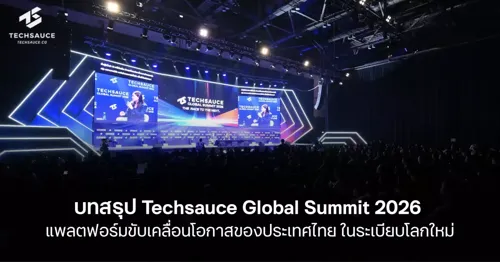
Techsauce Global Summit 2026 drew 60 countries with 350+ speakers, 1,000+ C-level executives, 500+ investors, and 1,500+ business matches. Key themes included AI/Agentic AI (with Dr. Kai-Fu Lee highlighting 175x cost reduction in 2 years), Healthspan as a regional hub opportunity, and Deep Tech commercialization via university partnerships. The platform positions Thailand/ASEAN to shift from low-cost manufacturing to a strategic tech-finance-policy hub, with emphasis on Enterprise AI systems, preventive healthcare innovation, and inclusive digital economy outcomes.

 Stop running your company on Excel.