
Archive
September 8, 2026

▾ Hover for summary ▾ Tap for summary
Central Food Retail's TOPS DAILY is launching three stores on Koh Chang by end-2024 (Haad Sai Khao, Chai Chet, and Bang Bao), targeting 1.14 million annual tourists and 10.4 billion baht in annual tourism revenue growing at 60%. The hybrid model combines TOPS DAILY with wine, bakery, and lifestyle concepts to maximize convenience across key tourist zones and integrate with Central's hotel and tourism ecosystem, with 141 of 560 current TOPS DAILY locations already in tourist areas.

▾ Hover for summary ▾ Tap for summary
Alexandr Wang, Meta's newly appointed Chief AI Officer, argues that young people should prioritize "vibe-coding"—using AI tools like Replit or Cursor to generate code via natural language prompts—over traditional syntax-based programming. Wang predicts AI will handle ~100% of code generation within 5 years, shifting the engineer role from code-writing to directing AI via human language. He recommends teens invest 10,000+ hours in mastering this skill. Major tech leaders (Google's Pichai, Nvidia's Huang) and companies (Microsoft, Google using AI for ~30% of production code) are already operating under this paradigm. The skill shift matters: those who excel at leveraging AI tools and articulating clear prompts will gain decisive advantage in the next-generation job market.

▾ Hover for summary ▾ Tap for summary
Thailand's Department of International Trade Promotion (DITP) is expanding premium tropical fruits (durian, mangosteen, longan, coconut) and processed agricultural products into DX Supermarket chain in Yuncheng, Shanxi Province. The initiative targets tier-2/3 Chinese cities with less competition than major urban centers, and studies Linyi pear model (1.2B yuan production value) to apply value-added farming and branding strategies to Thai agriculture for sustainable market growth.
▾ Hover for summary ▾ Tap for summary
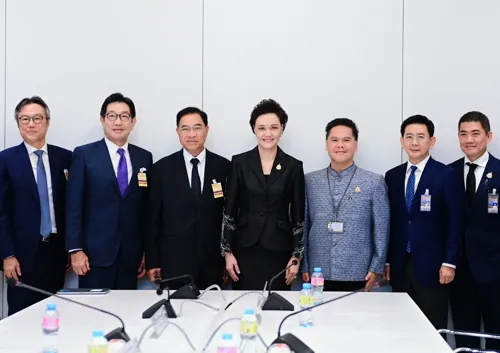
Thailand's Deputy PM and Commerce Minister (Supachai) met ITOCHU Corporation's president to elevate Thailand–Japan economic partnership from traditional manufacturing investment to "Co-Creation"—joint technology development, production, and business expansion into third markets and ASEAN. Key target sectors include advanced semiconductors, clean energy, food processing, EVs, data centers, AI, healthcare, and elderly-care services. The Thai government is accelerating regulatory reviews on energy, data centers, and food to attract investments that create jobs, transfer technology, and link local SMEs into value chains. The initiative marks a strategic shift ahead of the 140th anniversary of Thailand–Japan diplomatic ties in 2570, positioning Japan's technology and capital alongside Thailand's production base and ASEAN market access.

 Empower businesses to thrive in the digital age.

▾ Hover for summary ▾ Tap for summary
Thailand's economy is showing recovery signals through strong exports (up 21.6% in July), tourism revival, and private investment inflows, with consumer confidence hitting a 6-month high at 53.2 in August. However, September–October emerge as a critical inflection point: geopolitical tensions in the Middle East pushing oil prices near $100/barrel, ongoing ART trade negotiations with the US, and domestic political stability will determine whether recovery continues or stalls. Full-year GDP growth could reach 2.5% or higher if positive momentum holds, but oil-driven cost pressures and external risks pose downside threats.

▾ Hover for summary ▾ Tap for summary
Thailand's Stock Exchange is cutting IPO approval timelines from 165 days to 90 days through collaboration with SEC and investment bankers. Currently 10–15 IPOs expected for 2569 (down from 18 in 2568), but 2570 looks more promising with large deals in pipeline. New Economy listing criteria (effective Sept 11, 2569) and sector restructuring (especially tech) aim to attract tech startups and modernize the market. However, full pre-filing preparation still takes 1–3 years depending on company readiness.

▾ Hover for summary ▾ Tap for summary
Burger King Thailand is adapting to Middle East geopolitical tensions that slashed foreign tourist arrivals by redirecting focus to domestic customers (currently 80% of Bangkok/metro sales vs 20% in tourist hubs). Year-to-date growth is 2–3% with transaction growth at 4–5%. Q4 strategy includes a Dragon Ball collaboration launching Sept 8–Oct 18 with 10 themed menu items and limited-edition figurine sets to drive visit frequency from 2.3 to 3+ times/month. The company is also expanding non-core menu (rice dishes, congee, pastries at 39–69 baht) to shed its premium image and capture everyday customers, plus testing smaller 80-sqm formats to reduce capex.
▾ Hover for summary ▾ Tap for summary
Thailand's power development plan (PDP) public hearing revealed significant stakeholder concerns over LNG dependency, carbon capture storage (CCS) viability, and small modular reactor (SMR) feasibility. Key demands include full transparency on fuel-cost assumptions, reassessment of CCS as a core strategy given high costs, and acceleration of renewable energy targets to match Vietnam's pace. The planning committee indicated openness to revisions post-2037 and acknowledged renewable energy could be viable if cost assumptions and grid-stability concerns are addressed, but emphasized that all pathway options remain aligned with the country's Net Zero goals.
 Your real translator for LINE and Discord.

▾ Hover for summary ▾ Tap for summary
A Phuket residents' group petitioned authorities to ban a planned Jewish New Year (Rosh Hashanah) celebration scheduled for Friday, citing concerns that a large gathering would draw international conflict to the island amid the Israel-Iran tensions. Though framed as a safety issue, the action reflects broader tensions over Israeli visitor conduct in Thailand's southern tourism zones. Authorities acknowledged concerns but have not yet ruled on the event; organisers are requesting police protection.

▾ Hover for summary ▾ Tap for summary
Gold prices are consolidating after reaching ~$4,700/oz in August, now facing near-term headwinds from Fed rate-hike expectations, stronger USD, and the seasonal "September Effect." Huay Sang Heng identifies support at $4,200–$4,230/oz (66,500–66,800 baht), viewing this as a temporary pause rather than a trend reversal. Medium-to-long-term fundamentals remain supportive: geopolitical tensions, high government debt, and central bank accumulation continue to underpin demand.

▾ Hover for summary ▾ Tap for summary
Thailand's Cabinet approved the Startup Act framework on 8 September 2026, clearing the way for legal reforms to better accommodate startup fundraising and equity management. Limited companies established within 10 years, with average revenue not exceeding 300 million baht over the past 3 years, can self-certify through the National Innovation Agency (NIA) to access a 5-year benefits window (extendable to 10 years for deep-tech and agri-tech). This removes significant constraints in existing company law around capital-raising tools and international investment structures that startups routinely use, positioning Thailand as more competitive for startup ecosystems.

▾ Hover for summary ▾ Tap for summary
A leadership perspective piece on why large-scale organizational transformations fail despite sound strategic plans. The article identifies key failure patterns—ineffective one-way communication, leaders who delegate rather than model change, reliance on lagging indicators, and initiative overload—and argues that sustainable transformation requires leaders to visibly adopt new behaviors first and engage teams through discovery-based conversations rather than top-down directives.

 Want to buy or sell a business?

▾ Hover for summary ▾ Tap for summary
The Thai Cabinet approved 1.783 billion baht in financial assistance to Laos for the Chiang Khong–Vientiane bridge project. The government will provide 50% as a loan (891.8 million baht) with domestic financing, while the remainder comes from development cooperation funds. Benefits include reduced cross-border travel time by 30–45 minutes, projected increase in Nan province tourism by 80,000 visitors annually (360 million baht revenue), and strengthened Thailand–Laos economic connectivity aligned with regional integration strategy.
▾ Hover for summary ▾ Tap for summary
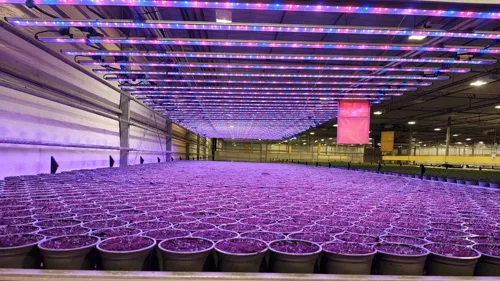
A startup is leveraging software-controlled lighting technology to reduce operational expenses in farming. This represents an innovation in agricultural tech that could help farmers optimize resource usage and improve cost efficiency—relevant for SMEs in Thailand's agri-tech sector looking to adopt smart farming solutions.

▾ Hover for summary ▾ Tap for summary
Robinson department store (Central Retail subsidiary) is refreshing its brand identity and launching a 47th-anniversary campaign (September 7–22, 2026) targeting multi-generational shoppers. The initiative introduces the "R STREET" fashion zone, emphasizes value-for-money positioning, and aims to grow sales 10% and traffic 12% year-on-year through fashion/lifestyle discounts (up to 50%), loyalty rewards, and community-focused experiences. Relevant for retail SMEs and consumer-discretionary trends in Thailand.

▾ Hover for summary ▾ Tap for summary
Accenture Song's research reveals a fundamental shift in customer experience: AI Agents are becoming intermediaries between consumers and brands, with 74% of consumers trusting AI to make purchase decisions and 85% open to collaborative decision-making. The key insight is that willingness to delegate varies by product category and individual moment—high-emotion purchases (travel, beauty) see partial delegation, while subscription and routine services see full AI control. Brands must redesign CX not by channel but by customer journey, allowing flexible control handoff as consumers move through the buying process rather than applying one-size-fits-all automation.
 Together GoWeGo! Ferry tickets in Thailand.

▾ Hover for summary ▾ Tap for summary
Thailand's SET index gained 26.6% year-to-date through August 2025 (+335 points), driven by 22.2% corporate earnings growth and diversified sector performance (energy, electronics, banking, ICT). August saw consolidation (-1.8% monthly) amid global rate pressures, but foreign investors remain net buyers YTD (51.2B baht, 55.3% of traded volume). Valuation remains attractive: Forward P/E 14.3x with 4.3% dividend yield outpacing Asian peers. Trading liquidity surged 62.6% YTD (avg 69.9B baht/day). Q4 support expected from government stimulus, budget acceleration, and high-season tourism.

▾ Hover for summary ▾ Tap for summary
OpenAI and Tenable have jointly announced an AI agent security review initiative, addressing growing concerns about autonomous AI safety and vulnerability management. This partnership signals industry recognition that AI agent deployment requires robust security frameworks. Relevant for Thai tech firms and SMEs considering AI adoption or vendor selection, though the full details remain inaccessible in the provided content.

▾ Hover for summary ▾ Tap for summary
Thailand's Cabinet has approved the framework for a new Startup Promotion Bill designed to remove regulatory barriers and enhance capital access for startups. Key provisions include a 5-year benefits window for eligible companies (established ≤10 years, revenue ≤300M baht, no dividends paid), allowing equity offerings, debt-to-equity conversions, stock vesting, and ESOP arrangements. The National Innovation Agency (NIA) will serve as a one-stop center providing financing support and coordinating benefits across immigration, IP, taxation, and procurement. Deep-tech and agriculture startups may qualify for extended benefits up to 10 years. This optional framework aims to unlock innovation potential and boost Thailand's startup ecosystem competitiveness.

▾ Hover for summary ▾ Tap for summary
Bill Gates warns in his latest memo that AI disruption poses unprecedented economic risk—potentially causing greater harm than good if poorly managed. Unlike past tech revolutions, AI's rapid adoption (operating on devices everyone owns, communicating in natural language) will displace mid-to-entry-level jobs faster than new skilled roles emerge. Gates highlights three key concerns: AI accuracy is improving rapidly despite current limitations; job displacement will hit sales, customer service, software engineering, and legal roles first; and accelerating robotics costs will create a cycle where adoption pressures companies to automate further, concentrating wealth. The core challenge: if AI eventually requires minimal human oversight, how will economies built on employment survive? This signals urgent need for policy frameworks on labor, wealth redistribution, and social safety nets.

 Stop running your company on Excel.